In the world of global manufacturing, the difference between a highly profitable facility and one that struggles to stay competitive often comes down to one core element: how they manage waste.
In Lean manufacturing, waste is known as Muda—any activity that consumes resources, time, or space but adds absolutely no value from the customer’s perspective. Through more than two decades of managing complex shop floors and driving corporate continuous improvement programs, I have seen millions of dollars slip through the cracks simply because teams could not see the waste staring right at them.
To achieve operational excellence, you must first learn to see through the lens of Lean. Today, we will break down the classic 7 Wastes of Lean Manufacturing, understand how they impact your bottom line, and explore practical strategies to eliminate them for good.
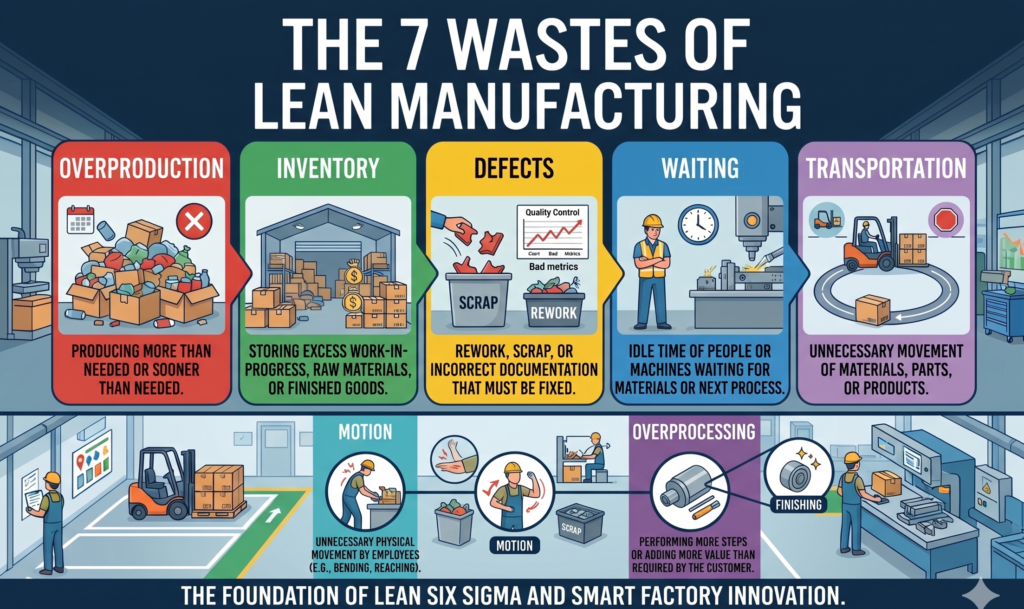
The Core Concept: Value vs. Waste
Before diving into the list, we must define what “value” actually means. Value is anything the customer is willing to pay for—such as transforming raw materials into a finished goods or components. Everything else is waste.
Lean divides waste into two categories:
- Type I Muda: Non-value-adding but necessary for current operations (e.g., quality testing).
- Type II Muda: Non-value-adding and completely unnecessary (e.g., moving parts back and forth because of poor layout). This is our primary target.
To easily remember the seven deadly wastes, Lean practitioners use the acronym TIM WOOD. The popular Lean acronym TIM WOOD serves as a strategic checklist to identify non-value-adding activities on the shop floor.
Transportation – Unnecessary movement of materials or parts.
Inventory – Excess raw materials, work-in-progress (WIP), or finished goods.
Motion – Unnecessary physical movement of operators or machinery.
Waiting – Idle time caused by process imbalances or material shortages.
Overproduction – Manufacturing items before they are required (the worst waste).
Overprocessing – Performing more work or tighter tolerances than the customer requires.
Defects – Rework, scrap, or incorrect documentation that demands correction.
Now, let’s analyze each one in detail.
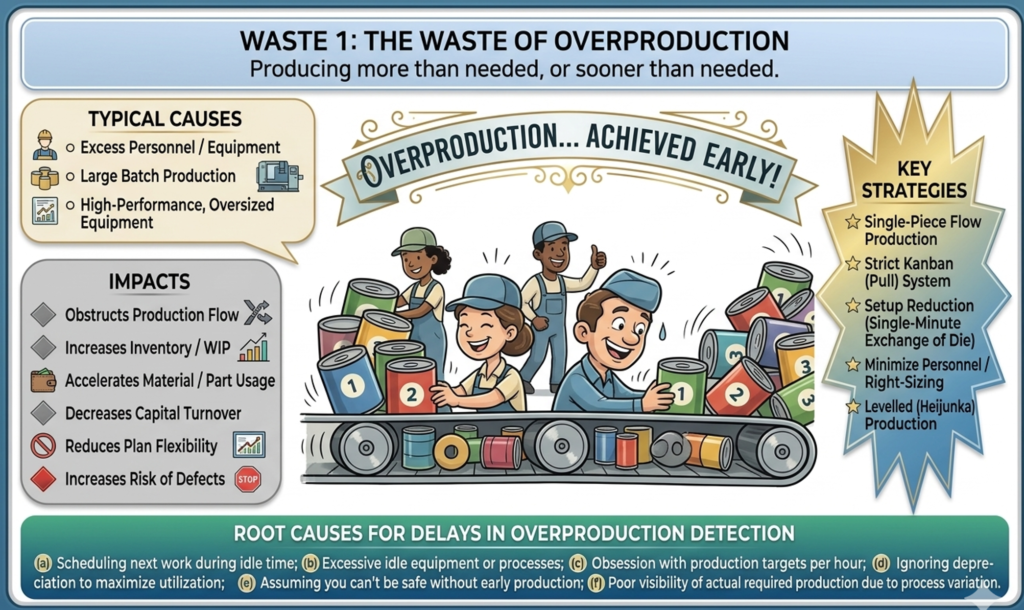
1. Overproduction
Overproduction is widely considered the most dangerous of all 7 wastes because it acts as a catalyst that creates and accelerates all the other forms of waste. It occurs when you manufacture items before they are required or in quantities larger than needed.
- Why it happens: The outdated urge to maximize local machine efficiencies, long setup times that discourage small batch runs, and a lack of real-time communication with downstream processes.
- The hidden cost: Overproduction floods the warehouse, creating massive Inventory waste, forcing unnecessary Transportation, and requiring extra handling (Motion). It creates a false sense of security while masking real operational issues.
- The Solution: Reduce changeover times using the SMED (Single-Minute Exchange of Die) technique, allowing you to run smaller batch sizes aligned with Takt time.
2. Transportation
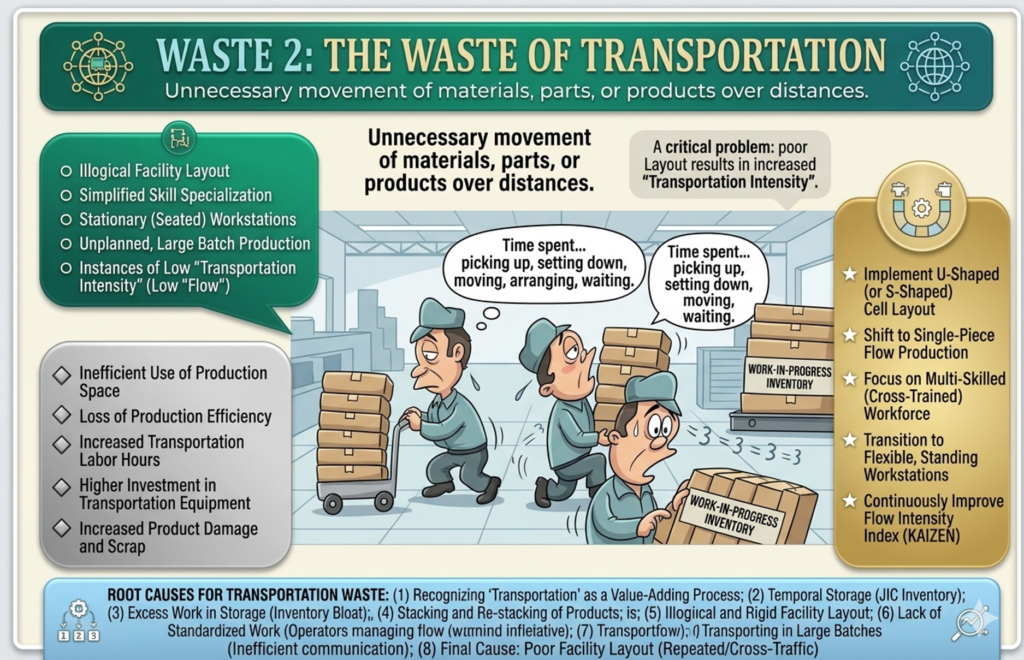
Transportation waste occurs when products, materials, or parts are moved unnecessarily between processes, warehouses, or workstations.
- Why it happens: Poor facility layouts, fragmented functional departments, and large batch production that requires material to be trucked to distant storage areas.
- The hidden cost: Every time a forklift moves a pallet of inventory, you incur labor, fuel, and equipment maintenance costs. Worse, unnecessary handling drastically increases the risk of product damage and workplace accidents.
- The Solution: Implement a Cellular Layout where sequential operations are placed adjacent to one another, minimizing the travel distance of raw materials and work-in-progress (WIP).
3. Inventory
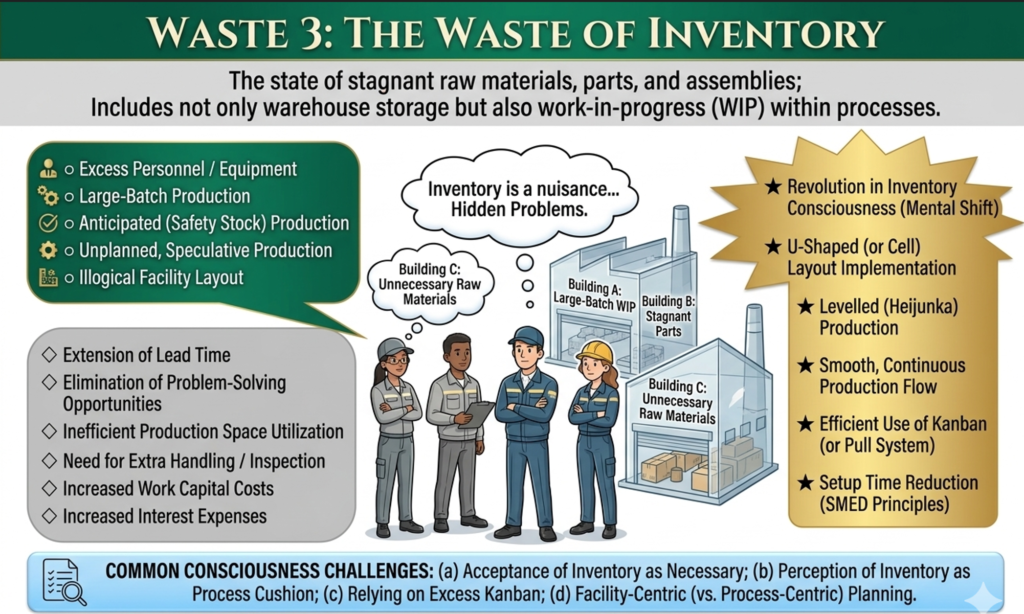
Inventory waste refers to any materials—whether raw materials, WIP, or finished goods—that exceed what is immediately required to satisfy the customer’s pull.
- Why it happens: “Just-in-Case” manufacturing driven by unreliable suppliers, inaccurate forecasting, or unbalanced production lines.
- The hidden cost: Excess inventory ties up valuable working capital and hides underlying operational problems like equipment downtime or quality issues. As the old Lean analogy goes, inventory is the water that hides the rocks of inefficiency.
- The Solution: Shift toward a Pull System (Kanban) and adopt a Just-In-Time (JIT) approach, allowing actual customer demand to dictate production levels.
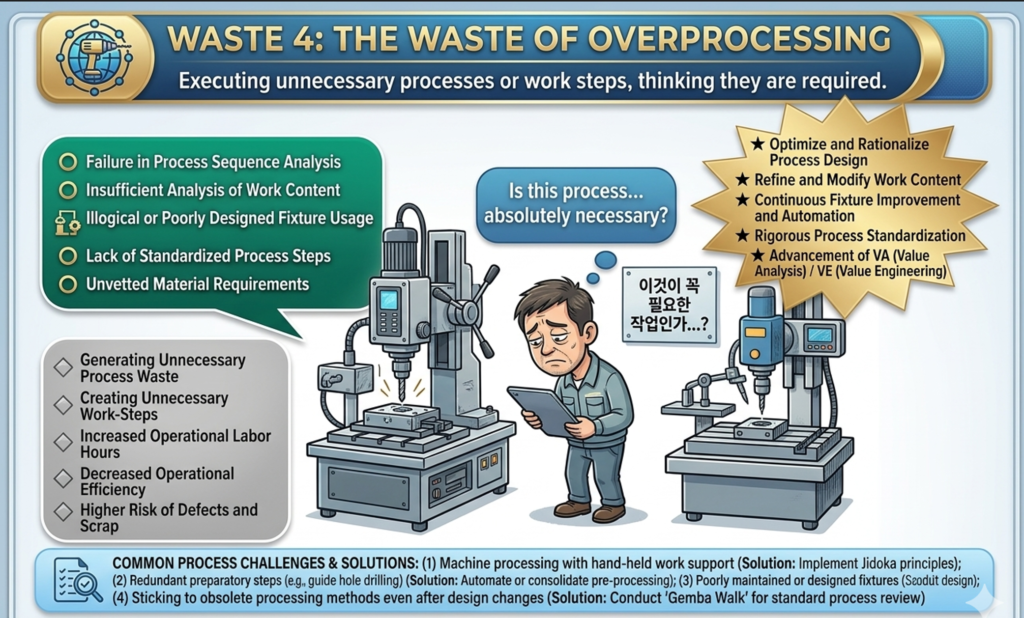
4. Overprocessing
Overprocessing waste happens when you perform more work on a product than what the customer explicitly requires or values. This includes using over-engineered equipment or executing tighter tolerances than necessary.
- Why it happens: A lack of clear standard operating procedures (SOPs), poor communication regarding customer specifications, or a culture of “doing extra just in case.”
- The hidden cost: Spending extra time polishing a surface that will be hidden inside an enclosure adds no value. It consumes expensive machine hours, increases tool wear, and slows down your throughput.
- The Solution: Review the “Voice of the Customer” (VOC) during the product design phase. Ensure SOPs clearly define exactly what is required—and nothing more.
5. Waiting
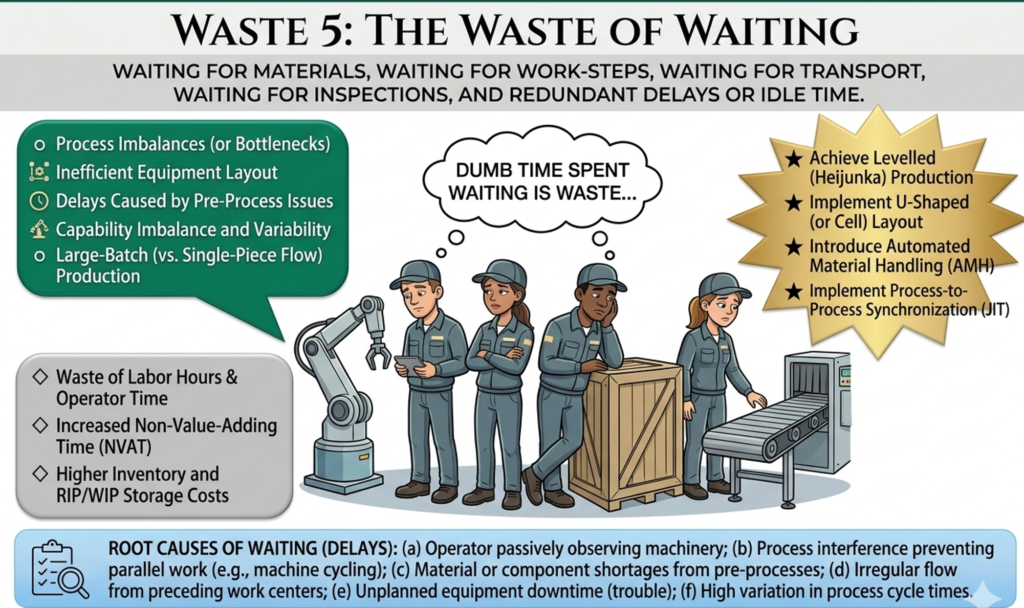
Waiting waste is the idle time that occurs when operators, machines, or materials are stuck waiting for the next step in the process.
- Why it happens: Unbalanced cycle times between workstations, unexpected machine breakdowns, material shortages, or delayed administrative approvals.
- The hidden cost: Waiting directly destroys your factory’s Lead Time. While a part sits on the floor waiting for an inspector, it adds zero value, delaying delivery and bottlenecking overall capacity.
- The Solution: Use Value Stream Mapping (VSM) to identify bottlenecks, perform line balancing, and implement Total Productive Maintenance (TPM) to prevent sudden equipment failures.
6. Motion
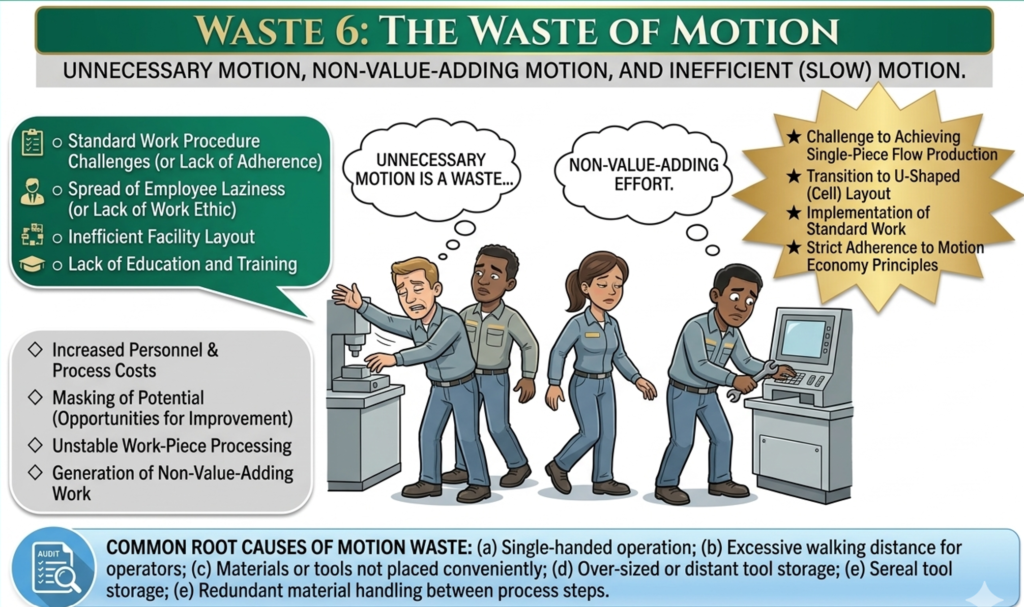
Unlike Transportation, which focuses on the movement of materials, Motion waste focuses on the unnecessary movement of people or machinery.
- Why it happens: Suboptimal ergonomic design, disorganized tool stations, or lack of standardized work procedures.
- The hidden cost: If an operator has to walk ten steps to grab a tool, bend down to lift heavy parts from the floor, or hunt through a cluttered drawer, they are burning precious time and physical energy. This leads to fatigue, lower morale, and ergonomic injuries.
- The Solution: Apply 5S methodology to organize workstations so that essential tools are within arm’s reach. Utilize motion-economy principles to design stress-free workspaces.
7. Defects
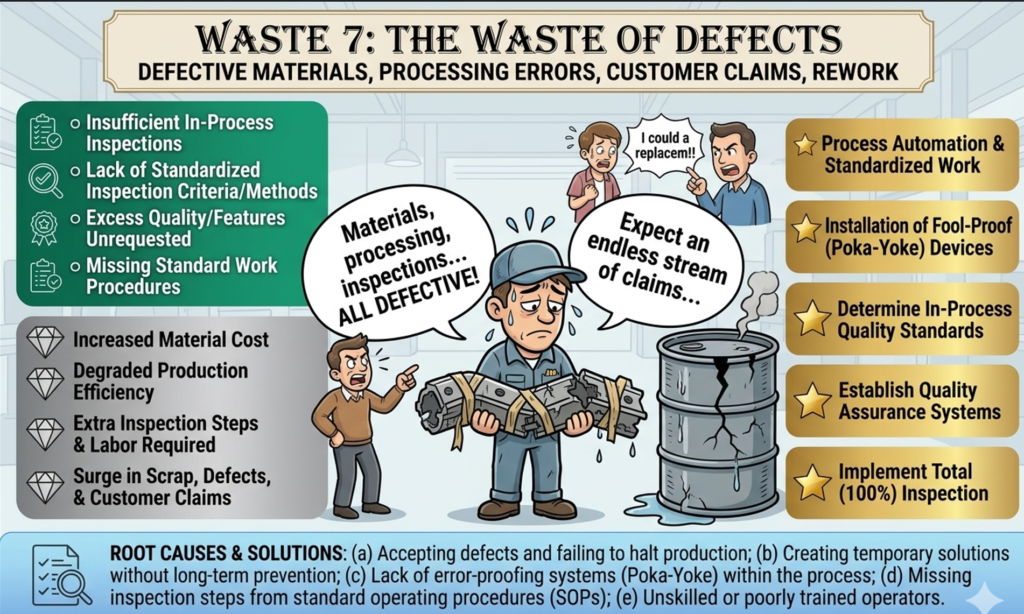
Defects are the most visible and easily understood form of waste. This includes any products or services that do not meet quality specifications, resulting in rework, scrap, or warranty claims.
- Why it happens: Inadequate training, poor raw material quality, out-of-calibration machinery, or lack of standardized processes.
- The hidden cost: Defects are pure financial loss. You lose the raw material, the energy consumed, the labor hours invested, and additional resources required to sort, inspect, and rework the flawed items. Furthermore, if a defect reaches a customer, it severely damages your brand reputation.
- The Solution: Implement Poka-Yoke (Mistake-Proofing) mechanisms that prevent errors from happening in the first place, and adopt Jidoka (Autonomation) to stop the production line automatically the moment an abnormality is detected.
Conclusion: Developing a “Waste-Elimination” Culture
Advanced technologies like AI, IoT, and Smart Factory automation are incredibly powerful, but if they are applied to an unoptimized, wasteful process, they will simply automate inefficiency.
True manufacturing innovation does not require a massive capital budget. It begins with developing a culture where every operator and manager has the eye to see waste and the authority to eliminate it. Walk your Gemba today with this checklist in hand. Identify just one major source of Waiting or Overproduction, and take the first step toward building a leaner, faster, and more profitable operation.
📌 Recommended Reading for Continuous Improvement Leaders:
- Link 1: The True Power of 5S: 5S Methodology Lean Strategy
- Link 2: SMART KPI : How to Turn SMART KPIs into Real-World Execution
Discover more from mfginsights.net
Subscribe to get the latest posts sent to your email.