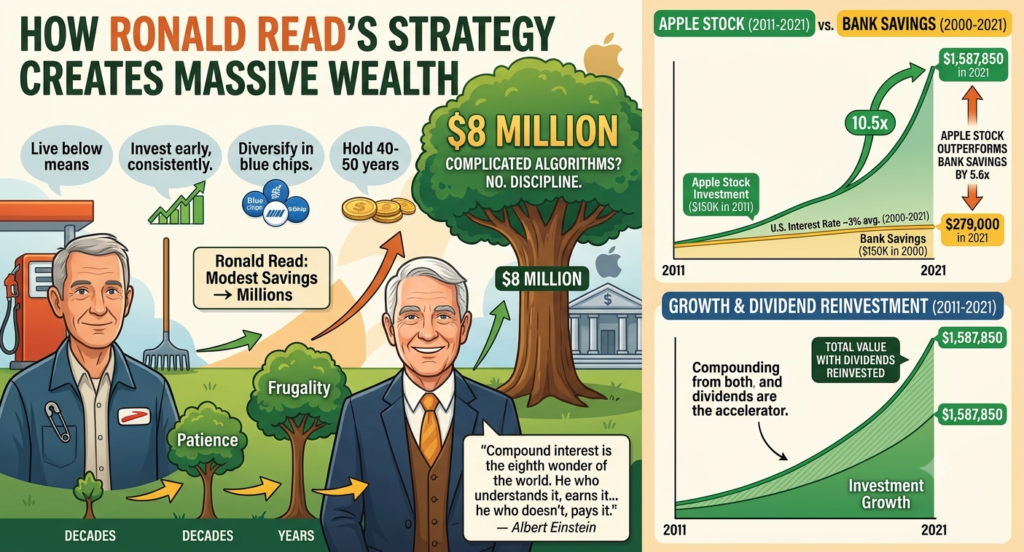
When people think of investing, they usually picture Wall Street suits, high-frequency traders, and complex algorithms. But one of the most successful investors ever wasn’t some hotshot hedge fund guy. He was actually a gas station attendant and janitor named Ronald Read.

When Read passed away in 2014 at the age of 92, he left behind a fortune of $8 million. His story offers timeless lessons for anyone looking to build wealth through the stock market.
1. Ronald Read’s Secret
Ronald Read’s greatest “secret” wasn’t a hidden tip; it was patience.
He started investing early and continued for decades.
By consistently reinvesting his dividends, he allowed the power of compounding to turn modest savings
into a multi-million dollar portfolio.
“Compound interest is the eighth wonder of the world. He who understands it, earns it… he who doesn’t, pays it.” — Often attributed to Albert Einstein
1) Live Below Your Means (Frugality)
Despite his growing wealth, Read lived a remarkably simple life. He drove a second-hand car, used safety pins to hold his coat together, and chopped his own firewood. This high savings rate provided the “fuel” for his investments. He understood that wealth is what you don’t see—the money invested, not the money spent on flashy displays.
2) Invest in What You Know and Hold
Read didn’t chase the latest tech bubbles or speculative “meme” stocks. Instead, he focused on Blue Chip stocks—established companies with proven track records of paying dividends.
- Diversification: He owned over 90 different stocks across various sectors (healthcare, rail, banks, and consumer goods).
- The Buy-and-Hold Strategy: He rarely sold. He ignored market volatility and held his shares for 30, 40, or even 50 years.
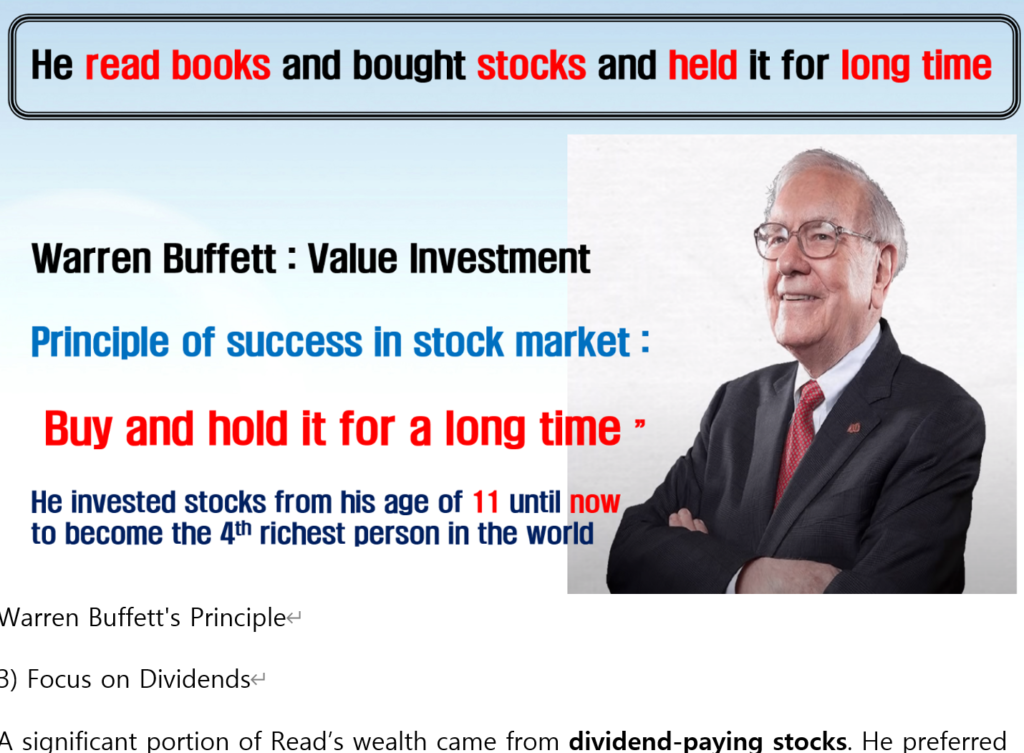
3) Focus on Dividends
A significant portion of Read’s wealth came from dividend-paying stocks. He preferred companies like Johnson & Johnson, Procter & Gamble, and JPMorgan Chase. These companies paid him to own their shares, and by automatically reinvesting those payments, his ownership in the companies grew exponentially without him needing to provide more capital.
4) Key Takeaways for Modern Investors
Ronald Read’s legacy proves that you don’t need a high salary or a finance degree to achieve financial freedom. The blueprint is simple:
- Start as early as possible.
- Spend less than you earn.
- Buy quality companies with a history of growth.
- Do nothing. (The hardest part of investing is often the waiting).
Ronald Read didn’t win the lottery; he won the game of discipline. His story remains a powerful reminder that while the market changes, the principles of long-term wealth creation remain the same.
What do you think about Ronald Read’s approach? Is it still possible in today’s fast-paced market?
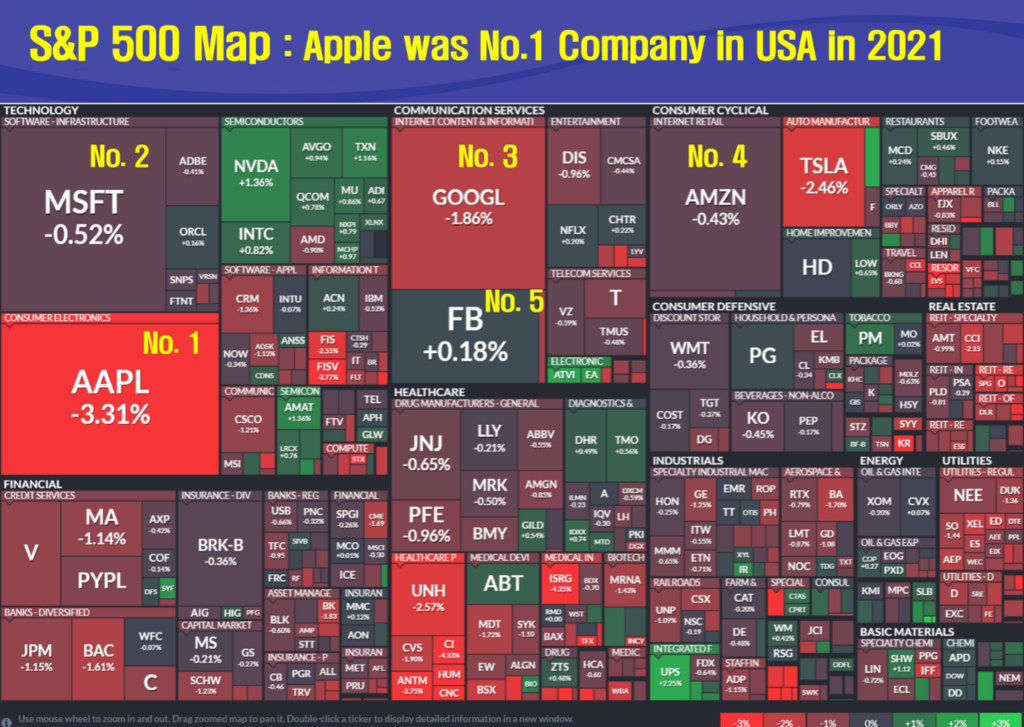
The following Apple stock chart proves that Ronald Read’s timeless investment strategy continues to deliver results even now.
If you had invested $100,000 in Apple stock in 2011 and held it for 10 years, it would have become $1,058,000.
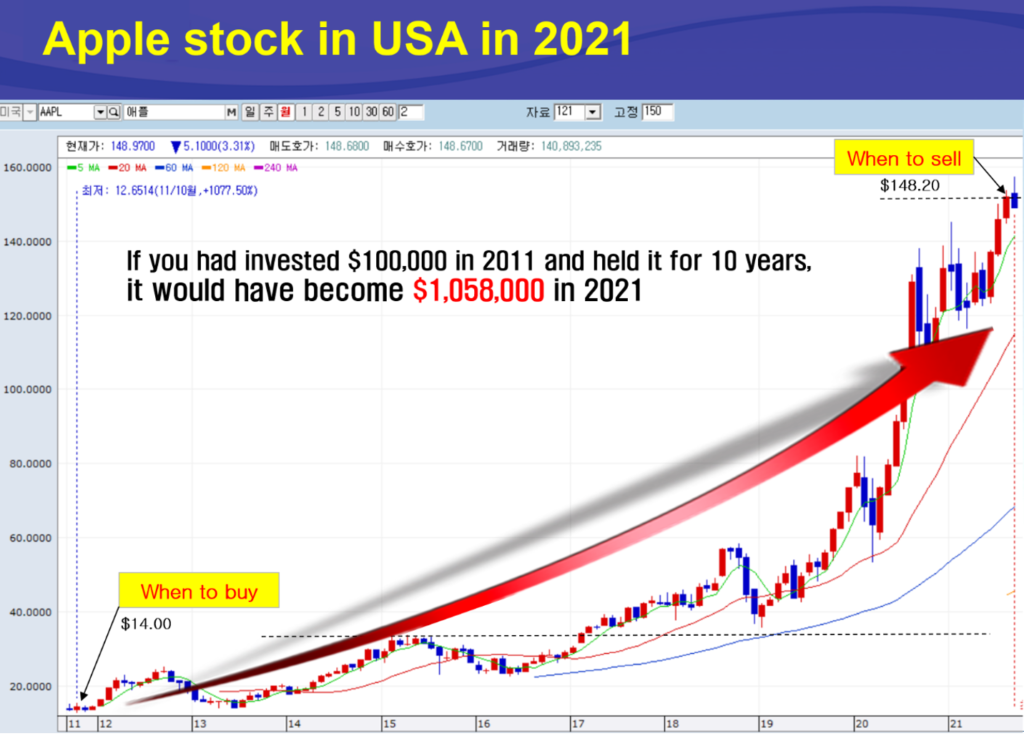
Detailed Analysis of the chart above
- Buying Point (When to Buy): In 2011, Apple’s stock price was around $14.00 (based on the split-adjusted price).
- Selling Point (When to Sell): At the end of the chart in 2021, the price reached approximately $148.20.
- Growth Curve: Although the chart shows periods of price drops or sideways movement—such as in 2013 and 2016—it ultimately demonstrates a powerful upward trend toward the upper right.
2. The Power Compounding : Connection to Ronald Read’s Philosophy
This image serves as perfect evidence to support the investment secrets of Ronald Read.
- The Magic of Compounding: As the stock grew from $14 to $148, the total returns would have been even more massive if dividends had been reinvested during that process.
- Patience: The chart visually demonstrates that those who practiced patience (Hold) for 10 years—without selling even during downturns like those in 2013 or 2019—eventually achieved a 10x return.
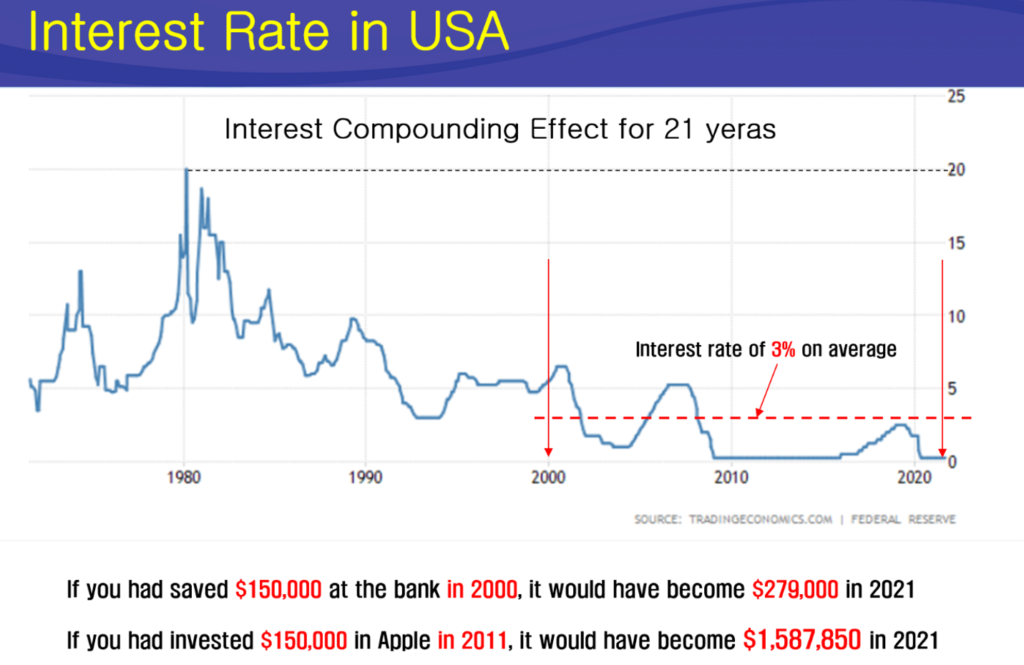
1) Analysis of the “Interest Rate in USA” Chart
This chart provides a compelling visual demonstration of why Ronald Read’s strategy of long-term stock investing outperforms traditional bank savings, especially when looking at the same initial capital.
2) The Context: A Long-Term View on Interest Rates
- The upper section shows the long-term trend of the U.S. interest rate. It highlights a historically lower interest rate environment after the year 2000, with an estimated 3% average over the 21-year period to 2021.
3) The Power of Direct Comparison
The core of this image is the two scenarios at the bottom, which now use an identical initial sum of $150,000, making the difference in outcomes a pure testament to the power of the investment vehicle.
- Scenario A: The Safe Route (Bank Savings)
- This shows a respectable, low-risk gain from a long-term (21-year) savings plan at a modest average interest rate.
- “If you had saved $150,000 at the bank in 2000, it would have become $279,000 in 2021.”
- Scenario B: The Wealth-Building Route (Apple Stock Investment)
- This is the critical proof-point. Despite starting 11 years later (2011 vs. 2000), the same $150,000 invested in a high-quality growth stock (Apple) generated over 5.6 times more wealth ($1.58M vs. $279K) than the 21-year bank savings.
- “If you had invested $150,000 in Apple in 2011, it would have become $1,587,850 in 2021.”
“This chart proves that patience with the right asset is the ultimate wealth creator.
Even starting later in a dominant market leader like Apple creates a fortune that traditional savings, over a much longer period, simply cannot match. This is the exact principle that Ronald Read used to turn his humble wages into millions.”
[Legal Disclaimer]
“The information provided in this post is for informational and educational purposes only. Any investment decisions are the sole responsibility of the investor, who bears all risks and consequences associated with such decisions.”
For more insights on manufacturing excellence and strategic transformation, read more post below.
Factory Turnaround Strategy in Vietnam
A Factory Turnaround Case Study: Turning Deficit into Profit in China
3 Lessons the Flea Experiment Teaches Us About Success
Discover more from mfginsights.net
Subscribe to get the latest posts sent to your email.