In today’s era of hyper-accelerated global competition, “innovation” is no longer a luxury or an optional line item on a corporate agenda—it is an absolute survival strategy. Across industries, companies launch ambitious transformational initiatives accompanied by grand slogans, flashing presentations, and substantial capital deployment. However, behind the glamorous kick-off ceremonies lies a sobering truth: very few corporate innovation projects ever bear the fruit they originally promised.
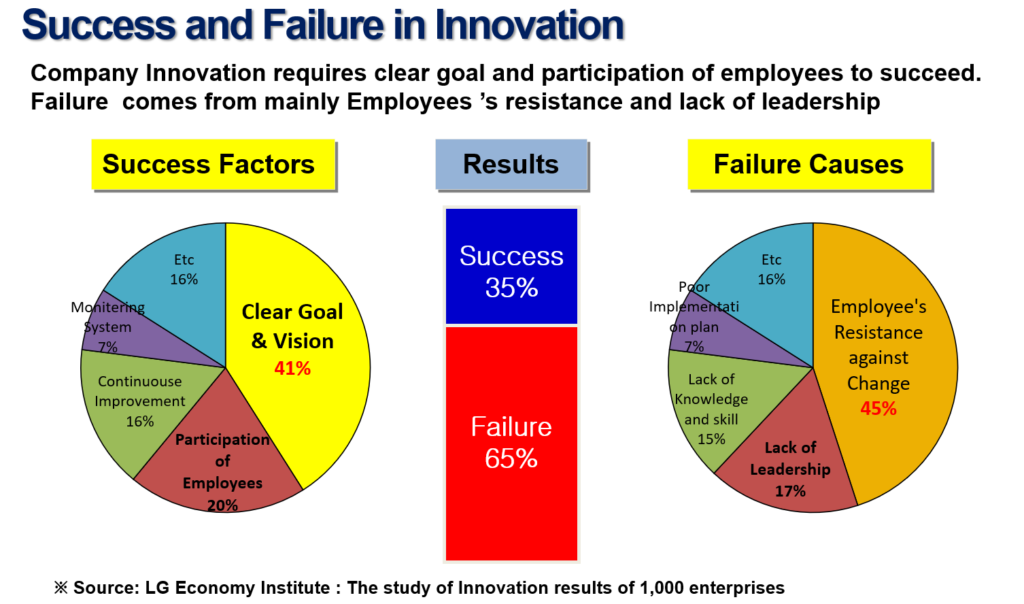
According to comprehensive empirical research conducted by the LG Economic Research Institute, which analyzed the long-term innovation outcomes of 1,000 global enterprises, the success rate of corporate innovation stands at a mere 35%. The remaining 65% of organizations taste the bitter disappointment of failed initiatives, wasted resources, and deflated morale.
Why does this massive gap exist between corporate aspiration and operational reality? Drawing from over 20 years of hands-on experience leading cross-functional transformations on the manufacturing floor, let us look past the buzzwords and precisely dissect the structural drivers of innovation failure and success.
1. The Root Causes of Failure: What Holds Organizations Back?
When an innovation project collapses, executive leadership frequently points to external variables: a lack of cutting-edge technology, shifting market dynamics, or budgetary constraints. However, granular data reveals a completely different reality. The structural barriers holding organizations back are overwhelmingly internal, behavioral, and cultural rather than technical or financial.
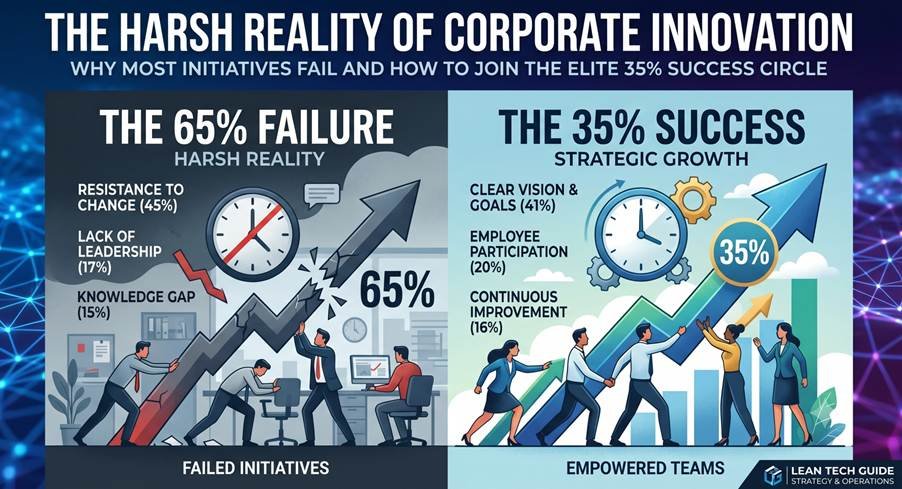
The most critical and devastating cause of failure identified in the data is employee resistance to change (45%).
From an evolutionary perspective, human beings are naturally wired to seek equilibrium and fear the unfamiliar. Even if a legacy business process is demonstrably inefficient, cumbersome, or outdated, it offers workers a psychological sense of security, predictability, and mastery. Forcing teams to abandon their deeply ingrained routines without proper alignment creates friction, passive resistance, and eventual operational rejection.
Following employee resistance, the next most critical failure factors are:
- Absence of Strategic Leadership (17%): Innovation rapidly loses its momentum and begins to drift aimlessly when the C-suite fails to articulate a consistent direction or follow through with visible commitment.
- Deficit in Organizational Knowledge & Capability (15%): A lack of concrete operational competencies and technical training required to execute the vision on the ground floor often stalls well-intentioned changes.
2. The Architecture of Success: Common Denominators of the Top 35%
Conversely, what sets apart the elite 35% of companies that successfully navigate the treacherous valley of change to achieve sustainable growth? The research highlights clear, repeatable patterns among high-performing innovators.
The single most powerful driver of successful corporate innovation is having a clear, well-defined goal and vision (41%). True transformation begins when leadership presents a compelling, transparent blueprint that answers the fundamental question every employee asks: “Why must we change, and what will our reality look like after this transformation?” When the entire workforce understands and internalizes this future state, the vision acts as an operational compass.
The second pillar of success is fostering voluntary employee participation (20%). Given that the primary cause of failure is employee resistance, flipping that exact friction point into proactive engagement serves as the ultimate turning point in any corporate transformation. When frontline workers are treated as co-authors of the change rather than passive recipients of a top-down mandate, their ownership skyrockets.
Finally, these top-performing organizations sustain their momentum by embedding continuous improvement activities (16%) and robust performance monitoring systems (7%) into their core operational architecture. This ensures that innovation transitions seamlessly from a one-off corporate event into permanent, self-sustaining organizational DNA.
3. The Human Factor: Innovation Powered by Empathy
Reflecting on more than two decades spent on the manufacturing front lines deploying and scaling Lean Six Sigma methodologies, I have learned one undeniable truth: Innovation is not an administrative management exercise; it is an exercise in human empathy and alignment.
As the data clearly demonstrates, real corporate transformation only materializes when an unmistakable vision connects with an energized workforce. It is about rallying teams together on the floor, uniting under a shared objective, and moving forward as a cohesive unit.
💡 4 Core Pillars for Sustainable Corporate Innovation
- Vision: Is your corporate objective so clear that every single member of the organization can articulate it convincingly in a single sentence?
- Leadership: Are your executive leaders actively embracing the new paradigms themselves, practicing visible accountability and leading from the front?
- Mindset: Is your management style focused on convincing teams of the absolute necessity of change, or are you simply enforcing compliance through top-down mandates?
- System: Have you established an institutionalized operational infrastructure that keeps improvement efforts continuous, preventing them from dissolving when focus shifts?
Which Side of the Statistics Will You Choose?
Ultimately, deciding whether your organization will remain trapped in the 65% failure statistic or rise into the top 35% success circle comes down to two leadership imperatives: strategic decisiveness and the human art of winning the hearts and minds of your workforce.
Innovation succeeds not because your technology is superior, but because your people are aligned. Today is the day to look past the corporate rhetoric and critically evaluate where your company’s innovation clock actually stands.
For more insights on manufacturing excellence and strategic transformation, read more post below.
Factory Turnaround Strategy in Vietnam
A Factory Turnaround Case Study: Turning Deficit into Profit in China
3 Lessons the Flea Experiment Teaches Us About Success
Discover more from mfginsights.net
Subscribe to get the latest posts sent to your email.