In the relentless pursuit of operational excellence, Lean Innovation helps manufacturing leaders face a continuous battle against an invisible enemy : waste (muda). Whether it manifests as a cluttered workbench on a factory floor, a poorly configured assembly line, or disorganized digital repositories in an administrative office, waste quietly drains productivity, inflates operational costs, and erodes employee morale.
This article explores a powerful, real-world case study in Lean innovation: the optimization of a footwear stitching production line, this example provides a definitive blueprint for driving manufacturing excellence.
Lean Innovation – Footwear Stitching Line Reconfiguration
The Challenge: Process Imbalance and Wasteful Transportation
In complex assembly operations, such as industrial footwear manufacturing, achieving efficiency through Lean Innovation is highly dependent on process synchronization. A traditional linear or fragmented layout often suffers from inherent structural flaws. In our analysis of a high-volume footwear stitching line, several critical inefficiencies were identified:
- Excessive WIP (Work-in-Progress): Imbalances in cycle times between sequential operators led to severe bottlenecks, leaving semi-finished components piling up between stations.
- Transportation Waste: Operators spent a significant portion of their shifts moving materials over long distances, which added zero value to the final product.
- Suboptimal Space Utilization: The expansive, traditional layout occupied an unnecessarily large footprint, limiting the facility’s overall capacity and flexibility.
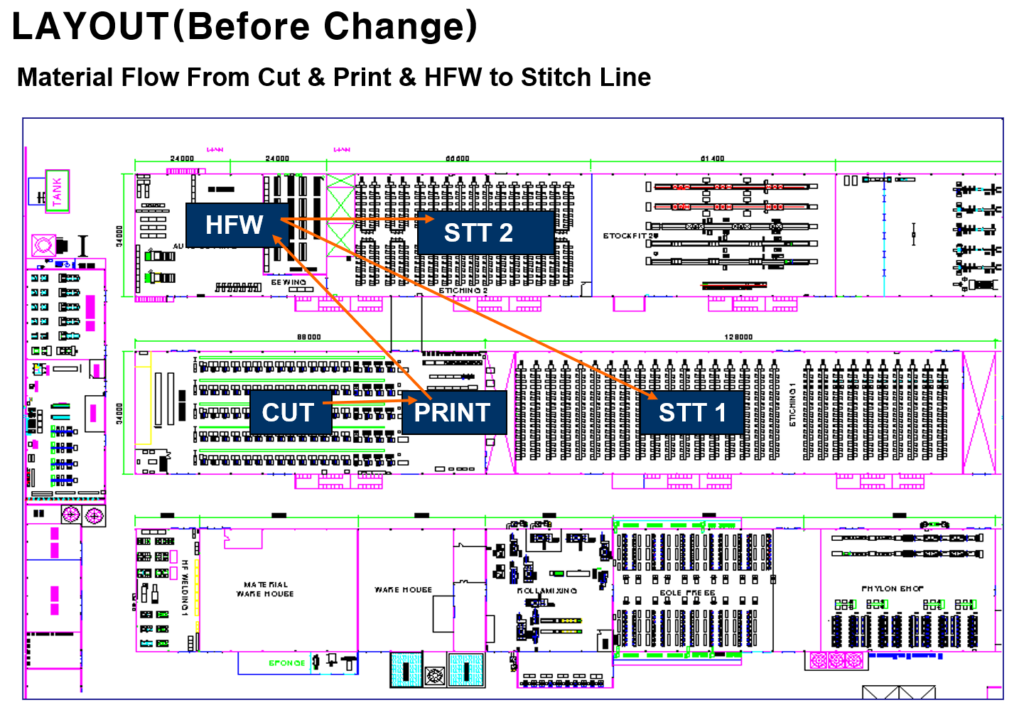
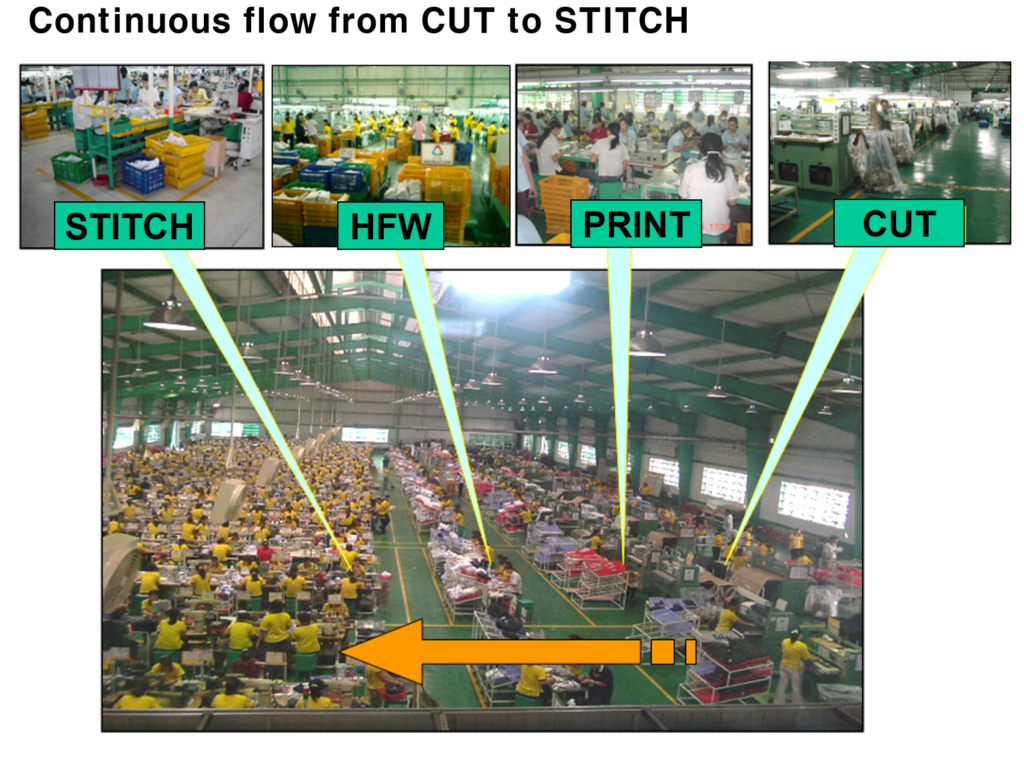
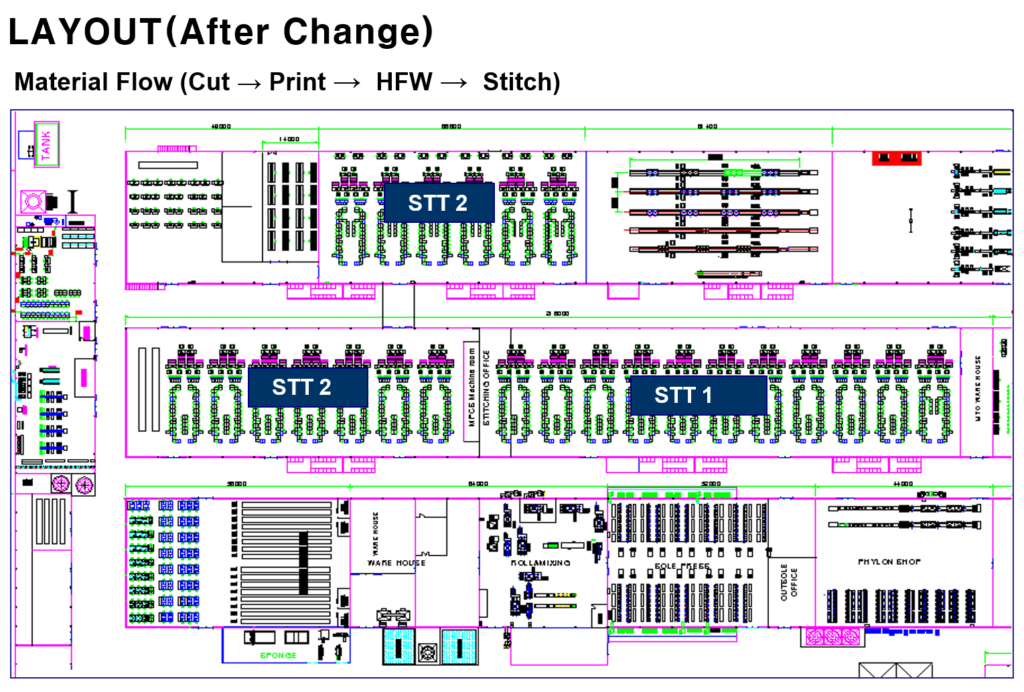
The Lean Solution: Cellular Manufacturing and Line Balancing
To eliminate these systemic losses, the traditional line was reconfigured into an optimized, high-efficiency manufacturing cell. The redesign focused on three core Lean pillars:
1. Layout Re-engineering (Cellular Design)
The physical distance between the preparation, stitching, and finishing processes was drastically minimized. By arranging workbenches in a compact, sequential cell, material transportation distances were cut by more than 50%.
2. Synchronized Takt Time and Line Balancing
Workloads were meticulously redistributed among operators based on precise time studies. Tasks were reallocated to ensure that each operator’s cycle time closely aligned with the calculated Takt time, successfully eliminating the primary bottlenecks.
3. Visual Standard Work and Flow Optimization
Clear visual cues and standardized work sequences were introduced. This ensured that components moved seamlessly from one station to the next in a single-piece flow, eliminating the chaotic batch-and-queue processing of the past. Here are the results of improvement.
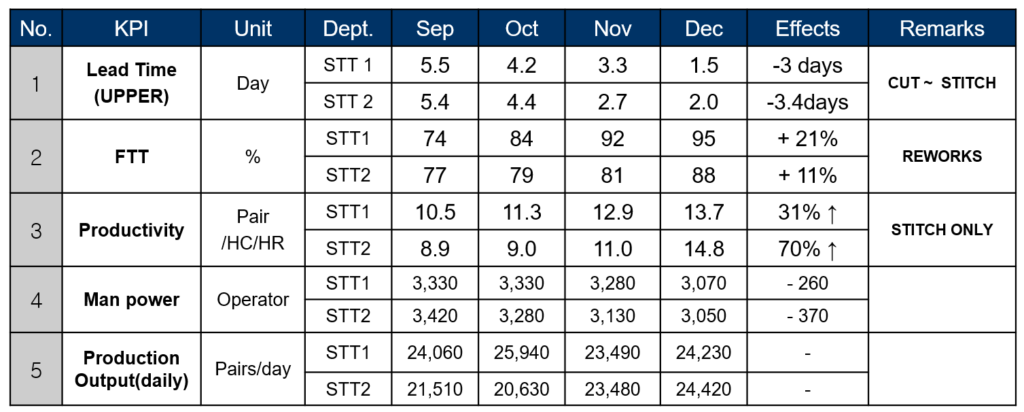
Sustained Post-Implementation Gains: A 4-Month Deep Dive (Sept–Dec)
Over this four-month period, the operational metrics reveal compelling proof of continuous improvement (Kaizen) in action:
1. Accelerated Volume and Throughput Growth
The line demonstrated a powerful compounding effect in its total output. In September, the newly configured cell delivered an impressive 29,000 pairs. As the operators adapted to the optimized cycle times and the flow became more stabilized, production surged consistently month-over-month. By December, monthly output peaked at 31,900 pairs—marking a remarkable 10% volume growth within just one quarter. This consistent upward trajectory proves that eliminating bottleneck waste directly unlocked hidden capacity without overdurdening the workforce.
2. Cumulative Financial and Structural Impact
When looking at the big picture, the aggregate achievements over these four months paint a definitive picture of manufacturing excellence:
- Massive Volume Delivery: The optimized stitching line successfully delivered a grand total of 121,800 pairs of footwear between September and December.
- Process Compression: By consolidating the manufacturing steps from 16 down to 14 processes, the operation eliminated unnecessary material handling and motion waste, ensuring that every movement directly added value to the product.
- Drastic WIP Reduction: Transitioning from 3 work-in-progress channels to 1 single-piece flow channel permanently lowered inventory holding costs on the floor and compressed the overall manufacturing lead time (L/T).
3. Radical Labor Cost Optimization: Saving 630 Man-Days of Input
A critical metric that highlights the massive scale of this operational triumph is the total reduction of 630 accumulated man-power slots (Man-Days/Hours equivalent) across the 4-month post-implementation window.
Strategic Labor Reallocation: This does not mean 630 individuals were laid off; rather, it means the organization liberated 630 man-days of highly skilled labor capacity. These resources were strategically reallocated to other high-priority production lines or new product development cells that were previously starved of manpower.
This case study clearly illustrates how Lean Innovation serves as a definitive blueprint for structural waste elimination.
Strategic Conclusion for Lean Leaders
The four-month trend data sends a clear message to operation executives: macro-level flow design creates sustainable predictability. The gradual increase in output from September to December indicates that when you remove physical clutter and balance the workload, the system naturally gains momentum.
By shrinking the physical footprint, implementing a single-channel flow, and sustaining a disciplined 85% line balance, the facility did not just hit its targets—it established a new, highly competitive baseline for world-class manufacturing productivity.
Recommended Reading :
3 Lessons the Flea Experiment Teaches Us About Success
The Power of the PDCA Report in 4 Steps
How to Achieve Down Time Reduction in Injection Molding
Discover more from mfginsights.net
Subscribe to get the latest posts sent to your email.