In the manufacturing industry, Down Time Reduction of injection molding machines is a critical KPI directly linked to productivity. Today, I would like to share a case study from an injection molding company in Malaysia, where a minor operational shift led to a massive boost in productivity.
1. Discovery: The Missing 60 Minutes on Injection Molding Machines
This facility operated 30 injection molding lines, producing everything from home appliance parts (washers, TVs) to large industrial pallets. Despite running two 8-hour shifts, each machine was consistently highlighting the urgent need for Down Time Reduction.
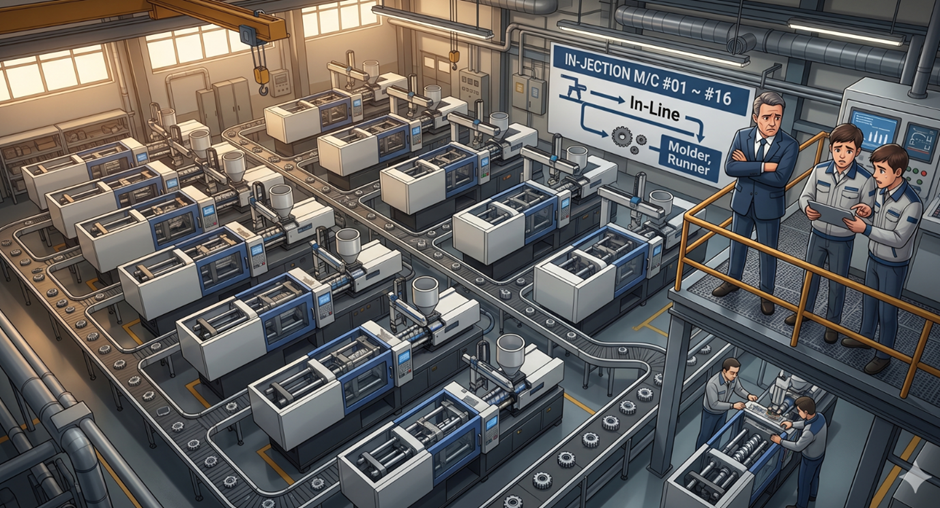
The culprit was unexpected: “Simultaneous Operator Breaks.” Workers operated in 2-person teams per machine, and because both operators took their 15-minute breaks at the same time, the entire production line came to a halt.
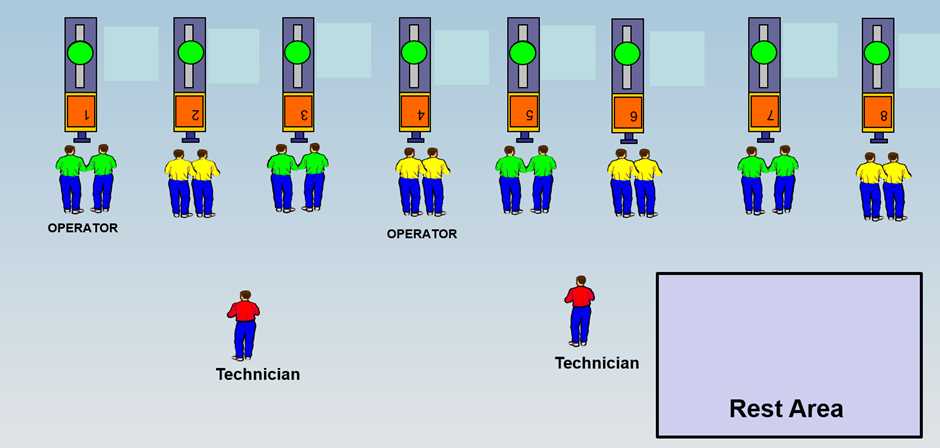
During the first morning break (10:00 AM – 10:15 AM), machines 2, 4, 6, and 8 would stop and enter standby mode (Red light). Meanwhile, machines 1, 3, 5, and 7 remained operational (Green light). However, the real issue started when the break ended. Technicians became overwhelmed trying to reset all the stopped machines at once. While two technicians worked on machines 2 and 6, machines 4 and 8 sat in “idle waste,” waiting for their turn. This is a classic Bottleneck caused by limited maintenance staff supporting large-scale operations.
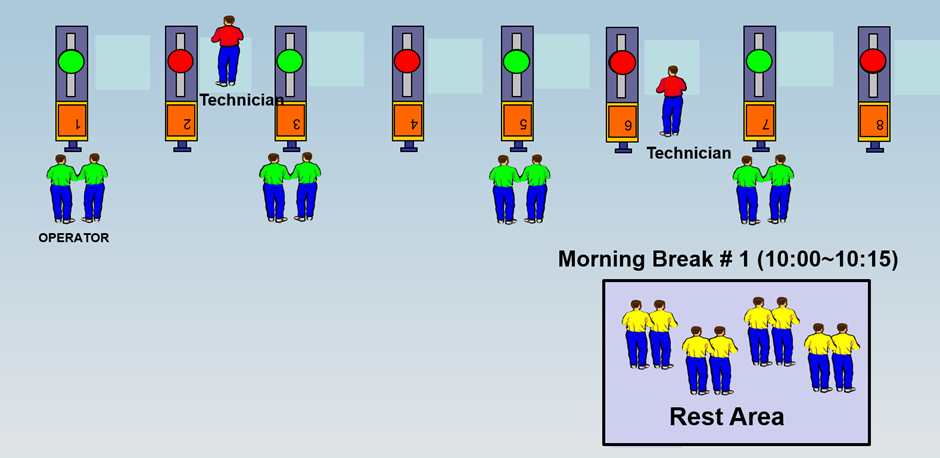
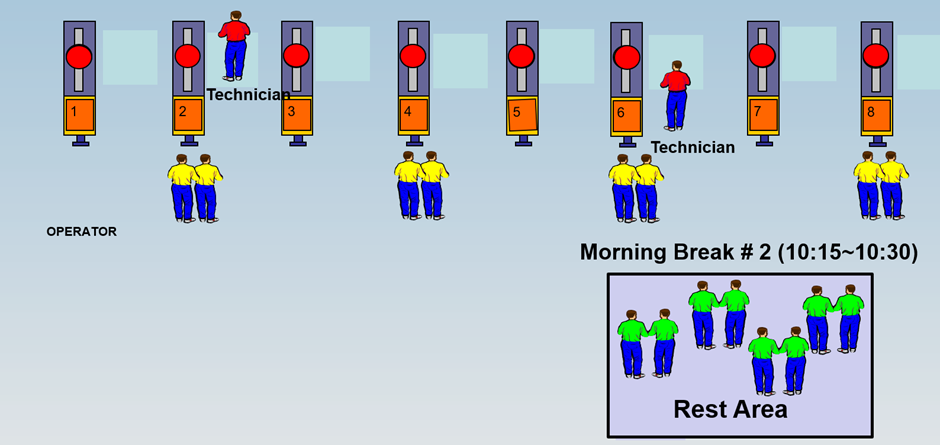
Due to limited breakroom space and a shortage of technicians, the breaks were split into two sessions. Although intended to be sequential (10:00 and 10:15), the reality was that by the second break period (10:15 AM – 10:30 AM), nearly all machines ended up in a stopped state due to cascading technical delays.
2. Technical Analysis: Why a 15-Minute Break Leads to 30 Minutes of Downtime
Why does a simple 15-minute break result in more than double the actual downtime? The answer lies in the technical mechanisms of injection molding:
- Disruption of Thermal Balance: Injection molders are precision machines operating under high heat and pressure. A 15-minute stoppage disrupts the internal thermal equilibrium.
- Resin Degradation: Resin sitting in the barrel can overheat and carbonize. To fix this, Purging (2-3 cycles) is required before restarting, leading to significant material waste.
- Mold Temperature Drop & Defects: Cooling water continues to flow even when the machine is stopped, causing the mold temperature to plummet. This necessitates 5 to 10 Dummy Shots to return to the target temperature, increasing the risk of dimensional inaccuracies or Short Shots.
- Technician Bottlenecks: Technicians must manually inspect each machine for hydraulic oil viscosity changes and nozzle solidification. This verification process adds another 10–15 minutes per machine.
Consequently, even after the break officially ends at 10:30 AM, the plant’s utilization rate often lingers at just 25%. As seen in the data, only the machines already adjusted by technicians resume work, while the rest remain idle.
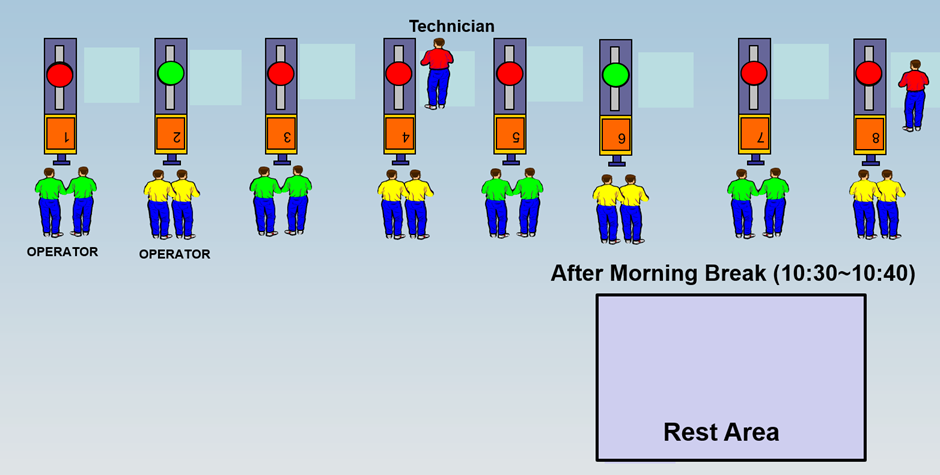
When combining morning and afternoon sessions, each machine recorded a staggering 50 to 70 minutes of downtime per shift.

3. The Solution: From “Simultaneous” to “Relay” Breaks
After brainstorming with the management team, the solution was surprisingly simple: “Relay-style Interchanged Breaks.”
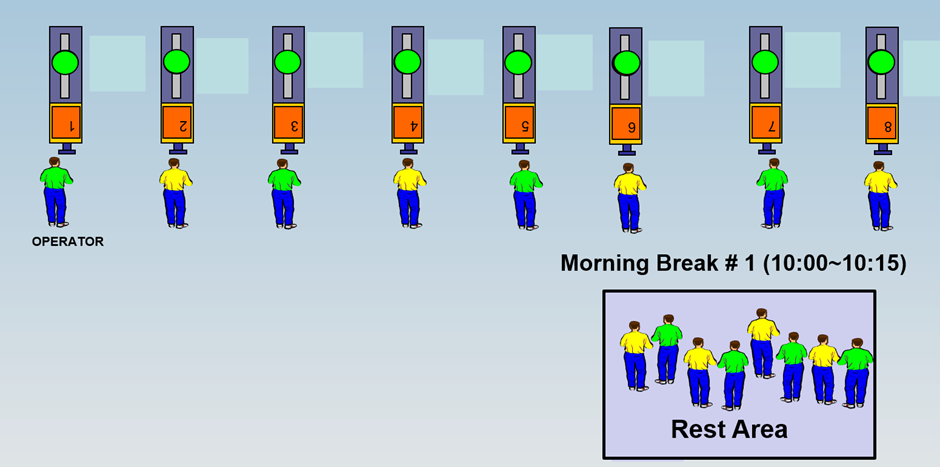
- Operational Method: One person from the 2-person team takes a 15-minute break while the other keeps the machine running. Once the first person returns, the second person takes their break.
- Core Principle: Maintain the Flow by ensuring at least one operator is always present at the station.
In the improved workflow, half the staff is on break, yet 100% of the machines remain operational, which means Down Time Reduction were made 100%. The green lights stay on, and production continues without interruption.
4. Incredible Results
Immediately after implementing this change, the factory saw dramatic improvements of Down Time Reduction
- Surge in Productivity: The 60 minutes of wasted time per machine, per shift, was eliminated. For 30 machines over two shifts, this reclaimed 3,600 minutes (60 hours) of production time per day.
- Cost Reduction: Material costs dropped significantly as the need for purging and dummy shots disappeared.
- Operational Efficiency: Technicians were freed from the “restart rush,” allowing them to focus on high-value Preventative Maintenance (PM).
- Stabilized Quality: Constant thermal balance led to a marked decrease in defect rates.
💡 Conclusion: Innovation Starts with a Change in Perspective
This case proves that massive productivity gains don’t always require heavy capital investment or complex automation. Often, it only takes a minor adjustment in work processes and a Lean mindset to challenge “the way things have always been done.” This is the heart of manufacturing competitiveness.
“Hungry for more? Check out these related posts.”
A Factory Turnaround Case Study: Turning Deficit into Profit
How to Turn SMART KPIs into Real-World Execution
3 Winning Habits of Leaders: Gemba & Lean Mindset
Discover more from mfginsights.net
Subscribe to get the latest posts sent to your email.