In the manufacturing industry, designing an efficient assembly line is a critical factor directly linked to productivity and cost reduction. Many small and medium-sized enterprises (SMEs) traditionally set up assembly lines using traditional conveyor belts. However, driven by extensive research on maximizing efficiency, a significant shift toward the Cell Production System has been taking place.
In this post, we will look into a detailed comparison between the traditional Conveyor Line vs Cell Line to help you identify the best approach for your factory innovation.
Conveyor Line vs Cell Line: At a Glance
| Category | Conveyor Assembly Line (Mass Production) | Cell Line (Lean/Cell Production) |
| Production Method | High-volume, Low-variety (Push System) | Low-volume, High-variety (Pull System) |
| Line Layout | Long, straight line (I-Shape) | Small-scale, compact cell (U-Shape or L-Shape) |
| Working Posture | Mostly Sitting (Fixed position) | Mostly Standing (Dynamic movement between processes) |
| Operator Capability | Single-skilled (Repetitive tasks) | Multi-skilled (Handles the entire process solo) |
| Pace Determined By | Machine (Conveyor belt speed) | Human (Operator proficiency & Takt Time) |
| Inventory Status | High Work-in-Process (WIP) accumulation | Minimized inventory (One-Piece Flow) |
Detailed Analysis of Core Differences
1. Control of Pace: Machine vs. Human
- Conveyor Line: Workers must adapt to the preset speed of the moving belt. Much like Charlie Chaplin’s classic film Modern Times, operators can easily become cogs in a machine. Any delay by a single worker instantly creates a bottleneck for downstream processes.
- Cell Line: Products are manually passed to the next station (often using chutes) upon task completion. This allows flexible pace adjustments based on the operator’s skill level and physical condition, maximizing productivity as proficiency grows.
2. Task Scope and Flexibility
- Conveyor Line: Workers remain fixed at their stations, repeating highly fragmented, simple tasks. When switching product models, the entire line must be halted for a major, time-consuming changeover.
- Cell Line: Operators engage in a “multi-process” flow—handling trimming, taping, and packing all at once. This agility allows immediate adjustment of Line of Balance (LOB) to meet small-batch orders seamlessly.
3. Physical and Psychological Aspects
- Conveyor Line: Working in a fixed, sitting position for hours puts severe pressure on the lumbar spine and easily induces complacency due to monotonous repetition.
- Cell Line: A standing position combined with regular movement promotes better blood circulation. Taking ownership of the entire assembly process boosts the operator’s sense of achievement and accountability for quality.
“Traditional lines represent ‘forced flow,’ while cell lines achieve ‘autonomous flow.'”
True manufacturing productivity depends on how efficiently an operator’s micro-movements are engineered. Even when the conveyor stops, optimizing the operator’s footsteps within a cell eliminates hidden waste and generates true profitability.
[Case Study 1] Optimizing a Plastic Injection Molding Post-Processing Line
This case study demonstrates the optimization of the post-processing and packaging line for plastic injection molded parts.
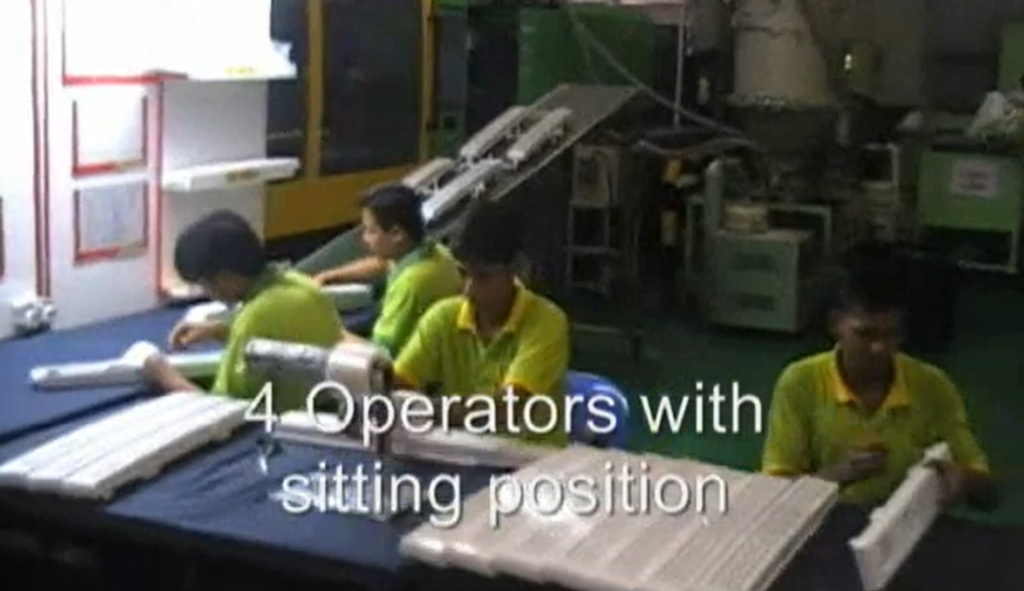
1. Before (4 Operators, Sitting Position)
- Workflow: Traditional assembly line setup.
- Manpower: 4 operators, all working in a fixed sitting position.
- Core Processes: Trimming, Taping, and Packing were strictly fragmented.
- Inefficiency: Due to tooling defects, there were 28 trimming points per part, causing an excessive workload.
2. 1st Attempt (Initial Optimization)
- Mould Repair: Reduced trimming points from 28 to 25.
- Manpower Reduction: Restructured the workflow to reduce staff from 4 to 3 operators, though they still worked sitting down.
3. 2nd Attempt: Completing the Standing Cell Line
- Precision Tooling Modification: Drastically cut trimming points down to 12 (a >50% reduction from the baseline).
- Standing Cell Implementation: Shifted the setup to a standing position.
- Multi-Process Flow: Configured a flexible cell where a single operator handles trimming, taping, and packing sequentially.
- Final Results: Manpower was further optimized from 3 to 2 operators. This achieved a 50% reduction in labor costs (from 4 to 2 workers) alongside a massive leap in productivity.
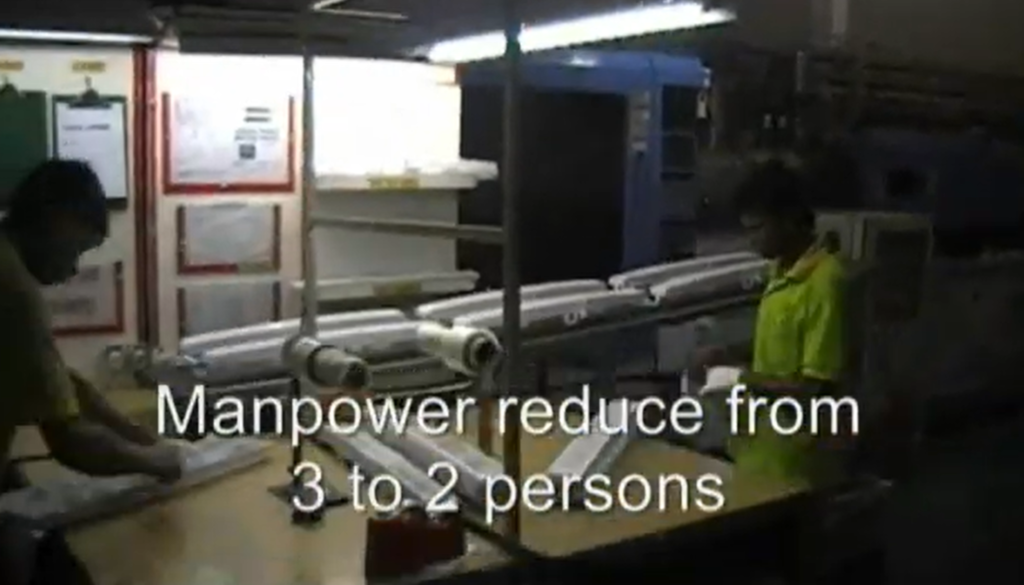
Real manufacturing innovation happens when hardware upgrades (precision tooling) meet software transformation (workflow restructuring). The moment a sitting worker transitions into a multi-skilled operator managing the entire flow, required labor drops by half while efficiency doubles.
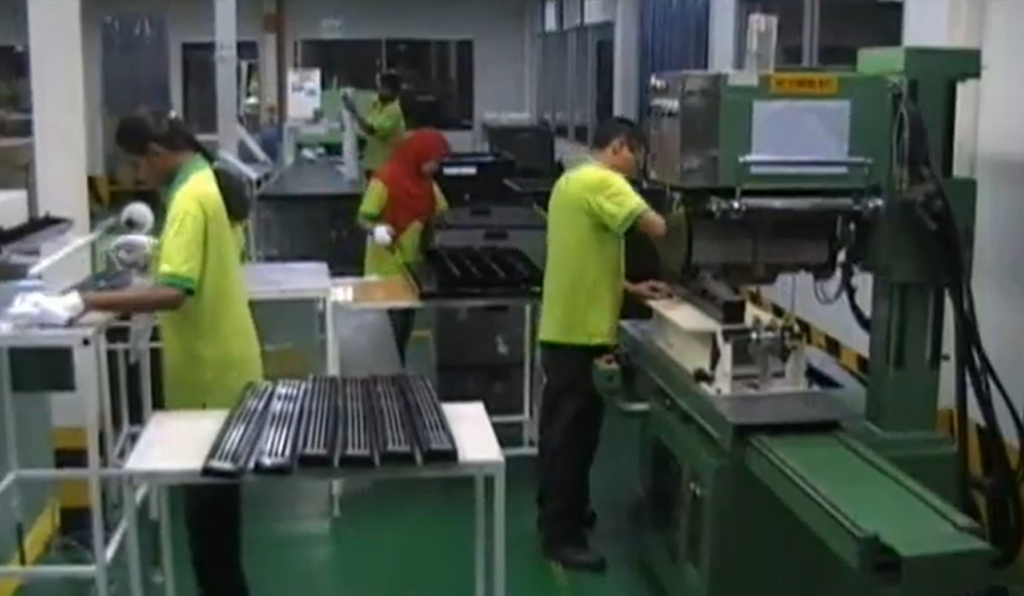
[Case Study 2] Cell Line Restructuring for a Hot Stamping Line
This case study highlights the performance gains achieved by integrating and relocating a 2-story assembly line into a compact, 1-story Cell Line at an automotive components factory.
1. Before: 2-Story Assembly Line
- Process Layout: A traditional assembly method with 5 operators positioned along a long, space-consuming conveyor belt.
- Footprint: Required substantial floor space due to the rigid conveyor system and needed 5 full-time operators.
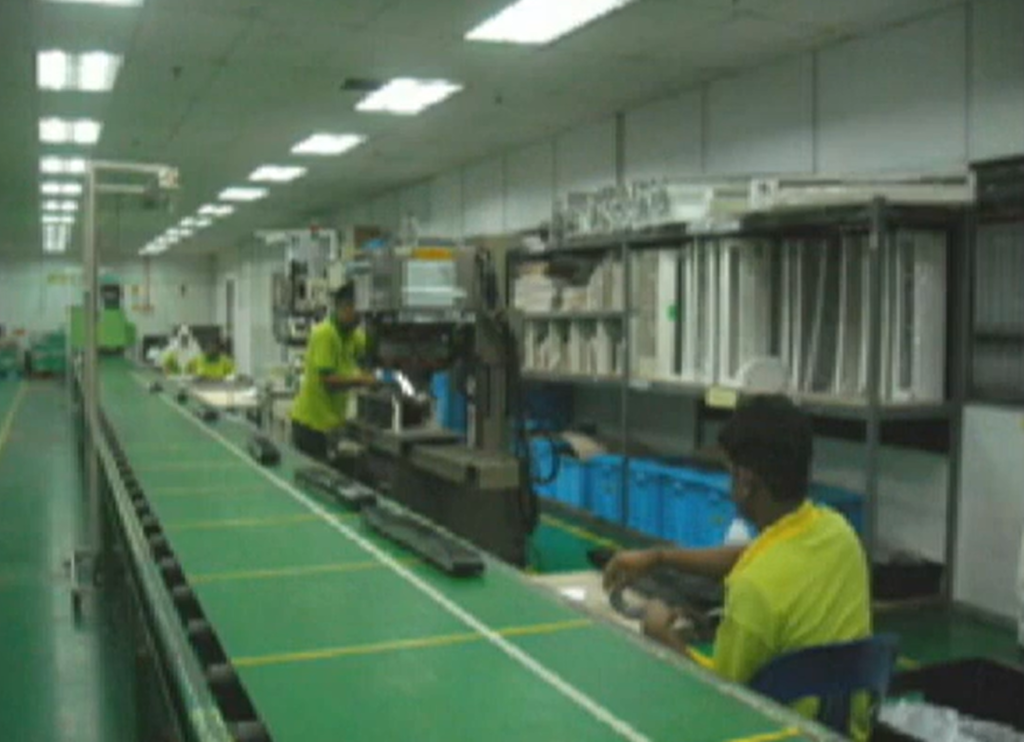
2. After: Transition to a 1-Story Cell Line
- Process Innovation: Shut down the rigid conveyor line and shifted to a dynamic Cell Line where each operator takes full responsibility for the entire process loop.
- Key Achievements:
- Labor Efficiency: Reduced headcount from 5 to 3 operators (40% labor cost savings).
- Quality Control: Achieved flawless defect control and improved overall product yield.
- Space & Energy Savings: Eliminating the conveyor belt drastically shrank the required footprint, cutting down the waste of transportation and power consumption.
- Accountability: Heightened individual ownership led to deeper engagement and better quality metrics.
💡 Deep Dive: Sitting vs. Standing Operations
“When analyzing a Conveyor Line vs Cell Line, the layout choice deeply impacts human ergonomics.” In a manufacturing plant, the choice between sitting and standing goes far beyond posture—it shapes productivity, ergonomics, and worker health. Here is a scientific look at why switching to a Cell Line captures both health and efficiency.
1. The Paradox of Sitting vs. Standing Work
Many assume that sitting down while working is physically less exhausting. In industrial environments, the reality is often the opposite. Fixed, repetitive sitting concentrates stress on specific muscle groups and the spine.
| Comparison Feature | Sitting Work | Standing Work (Cell System) |
| Energy Expenditure | Low (Static state) | High (~20–30% higher than sitting) |
| Working Radius | Narrow (Limited to arm’s reach) | Wide (Free movement, supports multi-process) |
| Spine Pressure | Concentrated on the lumbar spine | Distributed across the lower body (Better alignment) |
| Blood Circulation | Stagnant in lower limbs, lowers metabolism | Accelerated by active muscle contraction |
| Primary Pain Points | Lower back, neck, shoulders, pelvis | Soles of feet, calves, knees |
2. Ergonomic Benefits of a Standing Cell
Maintaining a single position for hours is detrimental. However, dynamic standing and moving is highly beneficial for musculoskeletal health and metabolic rates for several reasons:
- Spine Alignment: Standing naturally preserves the spine’s normal ‘S-curve’. Sitting increases pressure on lumbar discs by over 40%, whereas standing distributes the load safely.
- Metabolic Health: Continuous micro-movements help regulate blood sugar and boost calorie burn, mitigating risks associated with cardiovascular issues.
- Mental Alertness: Constant muscle engagement prevents drowsiness and increases blood flow to the brain, enhancing focus on quality control.
⚠️ Important Note (Avoid Static Standing): > Standing perfectly still like a sentinel can cause varicose veins or joint strain. The ideal approach is the Dynamic Standing found in a Cell Line, where operators stay active by moving between stations.
3. Health Guide for the Factory Floor : Conveyor Line vs Cell Line
- Anti-Fatigue Mats: Standing on hard concrete causes severe foot pain. Implementing cushioned anti-fatigue mats induces micro-movements in lower limb muscles, cutting fatigue levels by more than 50%.
- Optimal Workstation Height: Set workbenches about 5 to 10 cm below the operator’s elbow height to prevent shoulder and neck strain.
- Stretching Routines: Dedicating time before and after shifts to stretch calves and ankles is essential to prevent musculoskeletal disorders (MSDs).
Ultimately, a Cell Line keeps operators in a healthy, dynamic posture by design. It is a highly scientific management technique that simultaneously maximizes manufacturing output and extends the health span of your valuable workforce.
🔗 Recommended Readings From This Blog:
For more insights on manufacturing excellence and strategic transformation, read more post below.
Crushing Transportation Waste: Strategic Layout Innovation
Discover more from mfginsights.net
Subscribe to get the latest posts sent to your email.