Operational excellence in heavy manufacturing is a tightrope walk that requires both technical precision and visionary leadership. For over 30 years, I have navigated this challenging terrain, driving organizational transformation and managing complex operations across global manufacturing hubs in the USA, Canada, the UK, Korea, Vietnam, Malaysia, and China. Throughout this journey, I have formulated a distinct conceptual framework differentiating poor leaders from excellent leaders. Beyond abstract theories, my time on the shop floor has exposed me to the raw, unfiltered reality of the destructive traits of poor leadership. This article aims to distill these firsthand observations into a coherent analysis of the specific behaviors that characterize Poor Leaders, and their crippling impact on an organization.
The Reactive Micro-manager: A Case Study in Panic over Process
Management is fundamentally about executing standardized processes and maintaining operational stability utilizing proven analytical tools like Value Stream Mapping (VSM) and the PDCA cycle. An incompetent manager, however, thrives on a chaotic cycle of crisis and blame.
My observations revealed a consistent pattern: when critical problems arose, rather than investigating the root cause at the Gemba (the actual place of work), these individuals would retreat to their offices. Their standard operating procedure was to urgently summon key managers for an immediate interrogation. The goal was rarely to understand how a process failed, but almost exclusively to identify who was responsible, creating an atmosphere of enforced compliance and palpable irritation.

Furthermore, they substitute true guidance with an illusion of control through exhaustive reporting. If production fell short of target goals, instead of investigating process constraints, poor leaders would demand hourly reports detailing only the reasons for the shortfall. When technical issues were discussed, they would relentlessly ask “Why?” to assign blame, but showed absolutely no knowledge or interest in “How” to actually solve the problem. This represents the ultimate form of management by abdication.
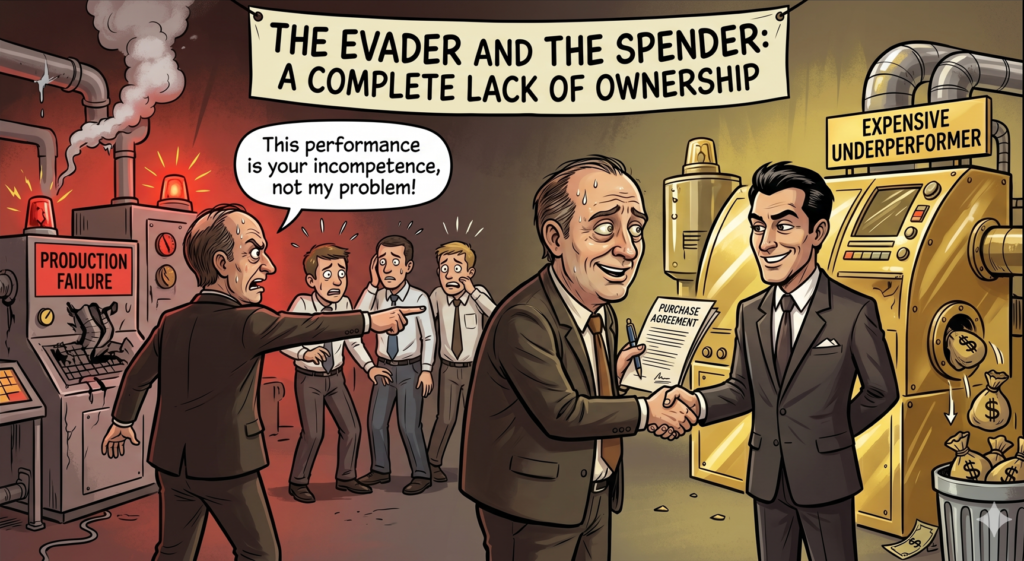
The Evader and the Spender: A Complete Lack of Ownership
The failures of a poor manager extend deeply into their sense of accountability and financial stewardship. When a crisis inevitably escalated, I frequently witnessed these managers artfully dodge any potential fallout. Instead of acting as a shield for their team, they were quick to point fingers, conveniently blaming poor performance on the “incompetence” of their subordinate managers.
This evasion of responsibility is always coupled with a profound lack of an “owner’s mindset.” Because they do not treat the company’s resources as their own, their decision-making is deeply flawed. I have seen managers who, when tasked with purchasing critical equipment, were easily swayed by the sweet talk and superficial promises of vendors. Lacking the technical depth to properly evaluate the machinery, they squandered company capital on expensive equipment that severely under-performed, ultimately damaging the factory’s long-term productivity.
The Defeatist Leader: A Failure of Vision and Coaching
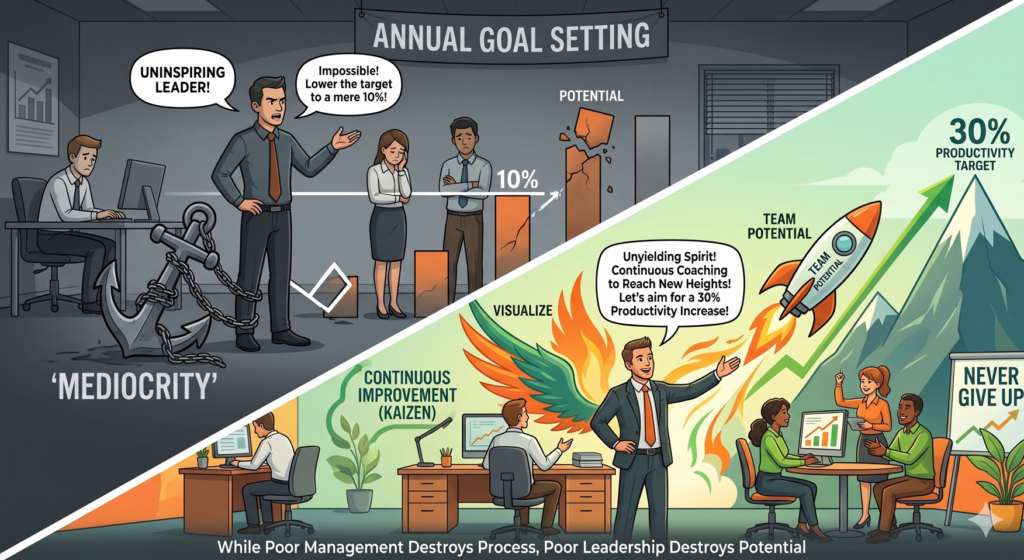
While poor management destroys process, poor leadership destroys potential. True leadership requires fostering an unyielding, “never give up” spirit and continuously coaching subordinates to reach new heights. A poor leader does the exact opposite.
A glaring example of this occurs during annual goal setting. When the organization needs a transformative push—such as aiming for a 30% increase in productivity through Lean methodologies—a poor leader will immediately dismiss it as impossible. Instead of inspiring the team to find innovative ways to bridge the gap, they inject negativity, arguing to lower the target to a mere 10% just to play it safe and protect their own performance evaluations. They anchor the organization in mediocrity rather than driving continuous improvement (Kaizen).
The Illusion of Teamwork: Covering Incompetence with After-Hours Drinks
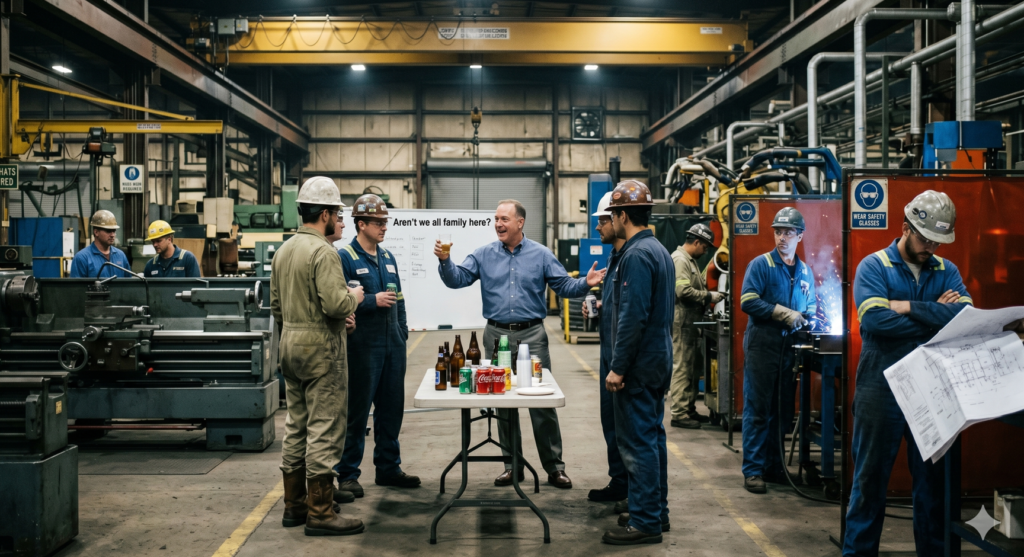
Perhaps the most insidious trait of a poor leader is how they attempt to mask their own lack of expertise. In a complex heavy manufacturing environment, leaders must continuously learn. However, when these poor leaders lacked professional knowledge, they made no effort to study the technical realities of the shop floor.
Instead, they relied on a superficial, antiquated approach to team building: buying drinks after hours. They mistakenly believed that taking the team out for alcohol and leaning on clichéd, overly personal phrases like, “Aren’t we all family here?” or “Are we strangers?” could magically forge teamwork. They attempt to buy loyalty to cover up the fact that they cannot offer professional mentorship or strategic direction during working hours. This does not build a high-performing culture; it breeds cynicism and disrespect among capable employees.
Conclusion: Recognizing the Impact on the Bottom Line
Reflecting on my three decades in manufacturing, it is clear that poor leaders are not simply a nuisance; they are a direct threat to a facility’s bottom line and future viability. The poor manager breaks the system through blame and reactive micro-management, while the poor leader breaks the spirit through defeatism and superficial leadership tactics.
A true operational turnaround requires an intentional and balanced application of both disciplines: the technical rigor to build stable, efficient systems, and the visionary leadership to challenge, coach, and truly empower resilient people. Recognizing these incompetent archetypes is the first critical step toward eradicating them and paving the way for sustainable transformation.
Read more: The Anatomy of Incompetence: Distinguishing Poor Leaders in Global Manufacturing💡 Further Reading & Resources:
For more insights on manufacturing excellence and strategic transformation, read more post below.
Discover more from mfginsights.net
Subscribe to get the latest posts sent to your email.