In global manufacturing, true operational agility is never dictated solely from the top down. The most sustainable process improvements, cost-saving measures, and safety breakthroughs are discovered on the factory floor by the operators, technicians, and engineers who interact with production machinery daily.
During my tenure as the legal representative and head of the manufacturing company in Vietnam, our leadership team faced a critical management challenge: How do we convert raw frontline insights into systematic, measurable business performance?
The answer lay in the formalized orchestration of our Employee Suggestion Program in 6 Steps. Launched as a core component of our lean operations strategy, this program was designed to incentivize innovative thinking, standardize cross-departmental problem-solving, and build an unshakeable corporate culture of bottom-up continuous improvement.
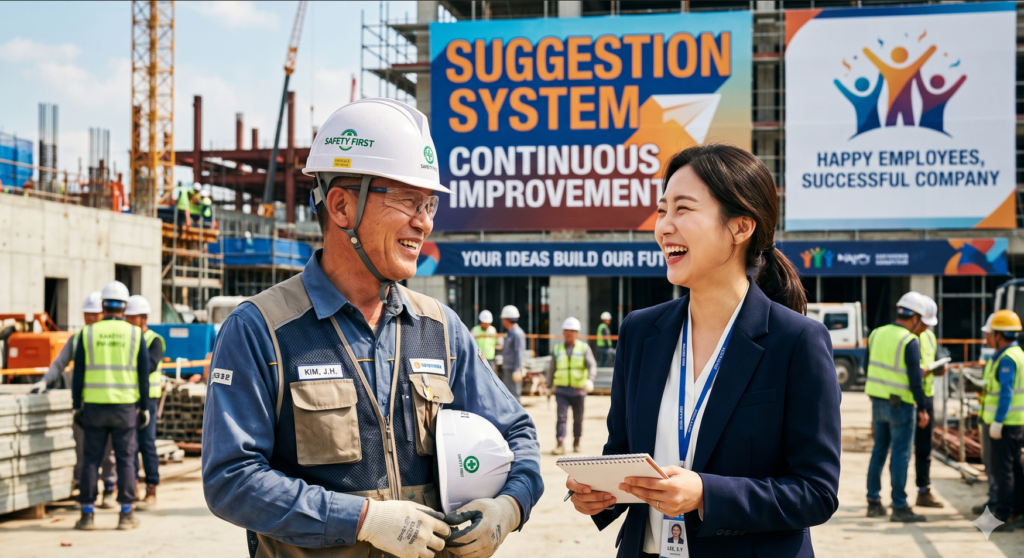
To maximize engagement, our leadership team set an aggressive benchmark: a target of one actionable suggestion per employee, every single month. By establishing a transparent submission pipeline, engaging direct managers as frontline innovation coaches, and offering highly attractive, top-tier electronic incentives, we successfully engaged our workforce to yield an average of 9,000 corporate suggestions per year from 1,000 employees on average.
This post outlines the exact structural design, evaluation metrics, and strategic leadership frameworks that turned our suggestion system into a cornerstone of industrial innovation.
1. Defining the Innovation Strategy: What Qualifies as a Valid Suggestion?
According to the official program charter, a Suggestion is formally defined as any useful research, invention, creation, improvement, or conceptual breakthrough regarding production, technology, quality, material handling, financial management, or organizational structure. These proposals can be put forward by an enterprising individual or a collaborative team.
The program was engineered to target five core areas of corporate performance:
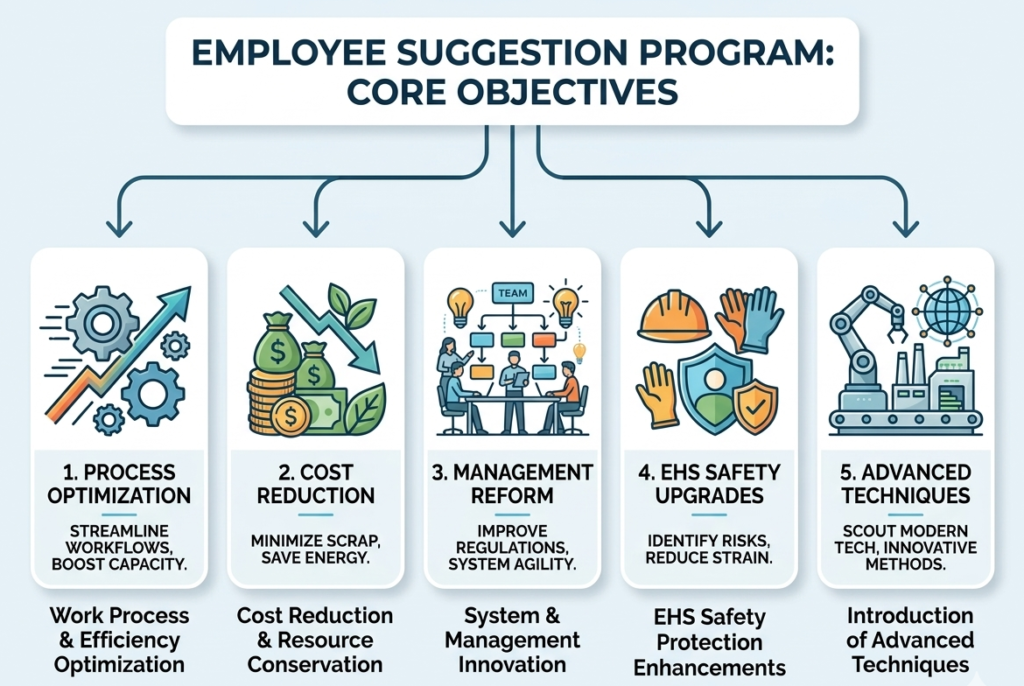
- Production & Work Process Optimization: Directly streamlining workflows on the shop floor to eliminate bottlenecks and boost manufacturing capacity.
- Cost Reduction & Resource Conservation: Maximizing the utilization of raw materials, minimizing scrap rates, and reducing utility or energy consumption across heavy manufacturing zones.
- Management, System, & Institutional Reform: Proposing progressive improvements to company regulations, administrative structures, software implementations, and organizational communications.
- Environment, Health, & Safety (EHS) Upgrades: Identifying safety risks, reducing physical worker strain (labor intensity), and establishing tighter protocols for industrial hazard protection.
- Introduction of Advanced Techniques: Scouting and proposing modern industrial technologies, cutting-edge equipment, or advanced management methodologies utilized by external industry leaders.
2. The Multi-Stage Operational Pipeline: Review to Closure
A high-volume ideas program will collapse into administrative chaos without a clear, objective workflow. To handle thousands of annual submissions cleanly, CS Wind Vietnam instituted a strict, dual-checkpoint vetting process managed by direct area heads and our dedicated Lean Department.
The Submission & Vetting Flow
The operational lifecycle of an employee proposal follows a precise pipeline:
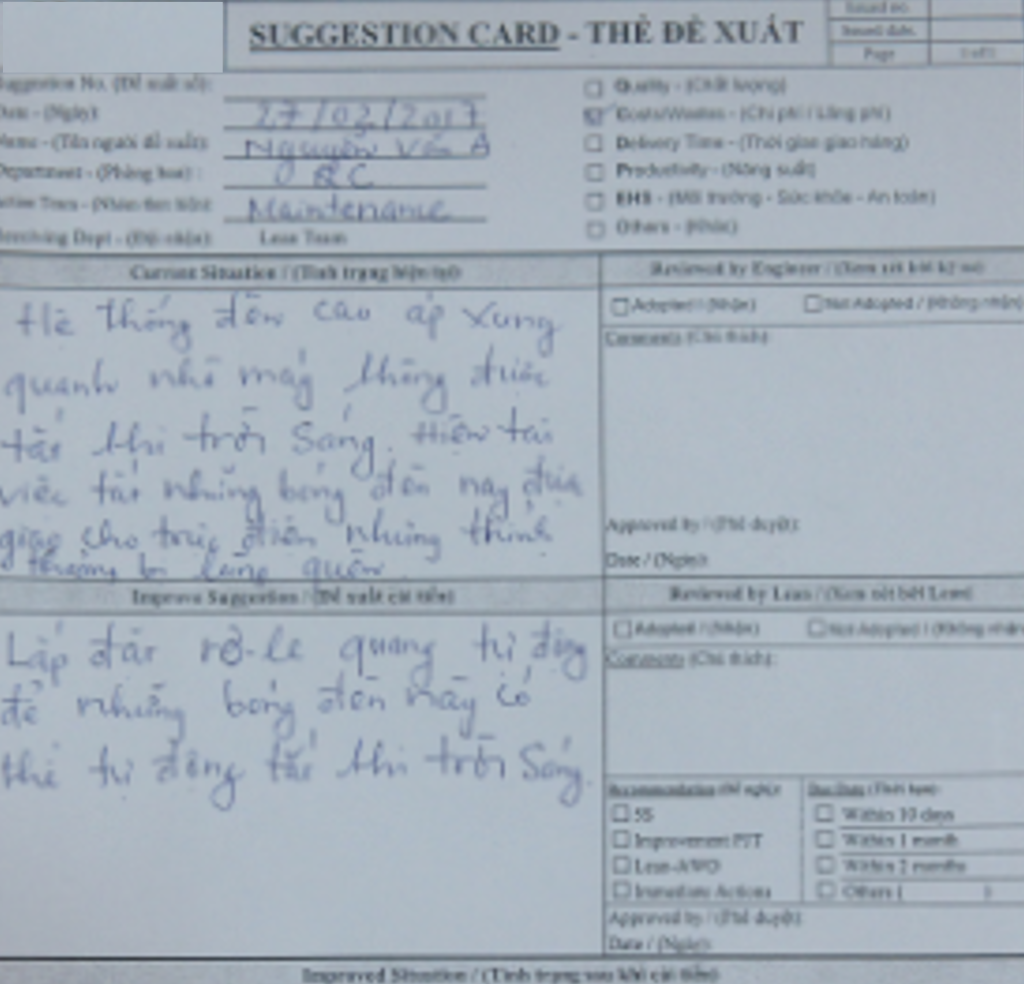
- Complete Documentation: The employee (proposer) fills out a standardized Suggestion Card entirely. This requires a specific description of the current problem alongside an objective, forward-looking solution proposal.
- Direct Manager Checkpoint: The direct supervisor (minimum engineer rank or equivalent) conducts the primary review. The manager’s role is critical: they evaluate the immediate effectiveness of the concept, coordinate across functions, and secure preliminary sign-offs from any target action team before giving their final signature.
- Lean Department Evaluation: Once approved by the department manager, the card is routed to the Lean Department. The Lean team analyzes the idea against broader plant operations to verify if the idea is technically executable and globally beneficial.
- Action Assignment & Registering: Approved ideas are registered in the active corporate project tracking ledger and assigned directly to a designated Action Team for deployment.
The Closing & Validation Procedure
An idea is never considered finished simply because it has been deployed. To ensure long-term sustainability, our system utilized a formal closing loop:
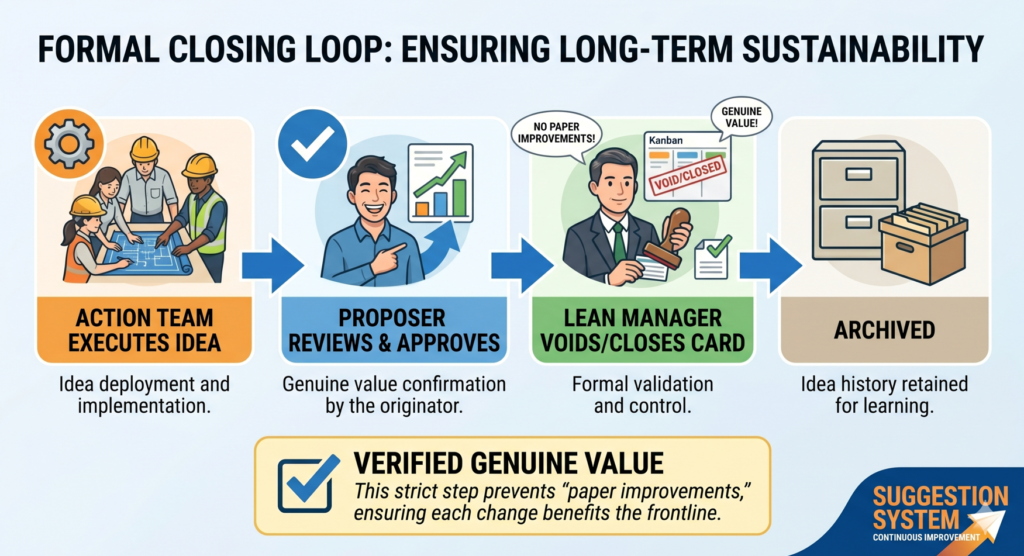
This strict closing step prevented “paper improvements” and ensured that every recorded modification delivered genuine value directly to the frontline personnel who requested it.
3. Standard Vetting Criteria: Vetting High-Quality Ideas
To keep the system running efficiently, our documentation clearly outlined what distinguished a high-yield suggestion from a basic workplace complaint.
Valid Inclusions
To be formally accepted by the Lean review committee, a card had to satisfy five core criteria:
- High Specificity: The current problem statement had to pinpoint specific machines, unique processes, exact locations, or verified raw material variances.
- Methodological Clarity: Proposals could not simply state a goal (e.g., “we must tighten quality checkups”). They had to explicitly outline the precise mechanical method, fixture modification, or procedural shift required to fix the issue.
- Exclusion of Existing Plans: Ideas were promptly disqualified if they were already part of an ongoing project plan, scheduled plant maintenance, or active capital expenditure budget.
- Beyond Standard Regulation: The card had to address a problem that could not be easily solved via existing company guidelines or standard Integrated Management System (IMS) documentation.
Elements to Avoid
The program explicitly rejected three types of submissions:
- Empty Adjustments: Simply adding vague descriptive words to a problem statement (e.g., converting “poor management” into “strengthen management”) without providing concrete actionable steps.
- Personal Grievances: Using suggestion cards to complain about personal conflicts, specific teammates, or group dynamics.
- Compensation Requests: Proposals that solely requested a personal pay increase, structural promotion, or expanded social welfare benefits.
4. The Suggestion Matrix: Credits, Grades, and Weighing
To maintain absolute transparency and eliminate bias, every accepted card was graded using a standardized matrix based on financial impact, safety improvements, and operational duration. The maximum value achievable for a single submission was capped at 150 credits, with each individual credit valued at 2,500 VND.
Standard Program Grading Structure
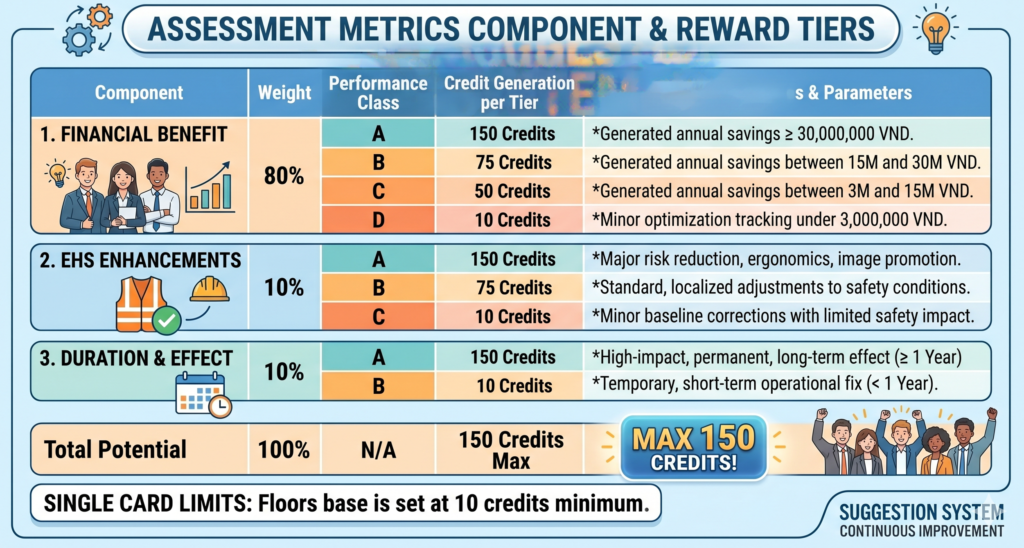
Administrative Award Categories
To ensure fairness for all submitted ideas—even those stalled by external roadblocks—the program utilized three distinct credit tiers:
- Consolation Prize (6 Credits): Awarded when an idea was verified and approved by the frontline manager but ultimately rejected by the Lean Department due to broader plant integration constraints.
- Adopted Award (8 Credits): Awarded when an idea passed both manager and Lean verification but could not be implemented due to external, objective circumstances.
- Accomplishment Award (Actual Matrix Score): Awarded to fully deployed, high-impact improvements, tracking directly to the real-world value generated by the project.
5. Driving Engagement: Top-Tier Incentives and Leadership Commitments
While clear metrics and structured processes are vital, an employee Suggestion Program only thrives when it captures the enthusiasm of the workforce. To sustain our target of one suggestion per person each month, our leadership framework focused on two main drivers: high-impact personal rewards and active management coaching.
High-Impact Year-End Incentives
To supplement the standard point-to-cash conversions, our leadership team introduced an elite competitive tier to celebrate our top innovators.
Twice a year, in June and December, a formal Suggestion Committee reviewed all compiled metrics. At our grand year-end ceremony, the two employees who racked up the highest overall matrix scores were publicly awarded the newest Apple iPhone models.
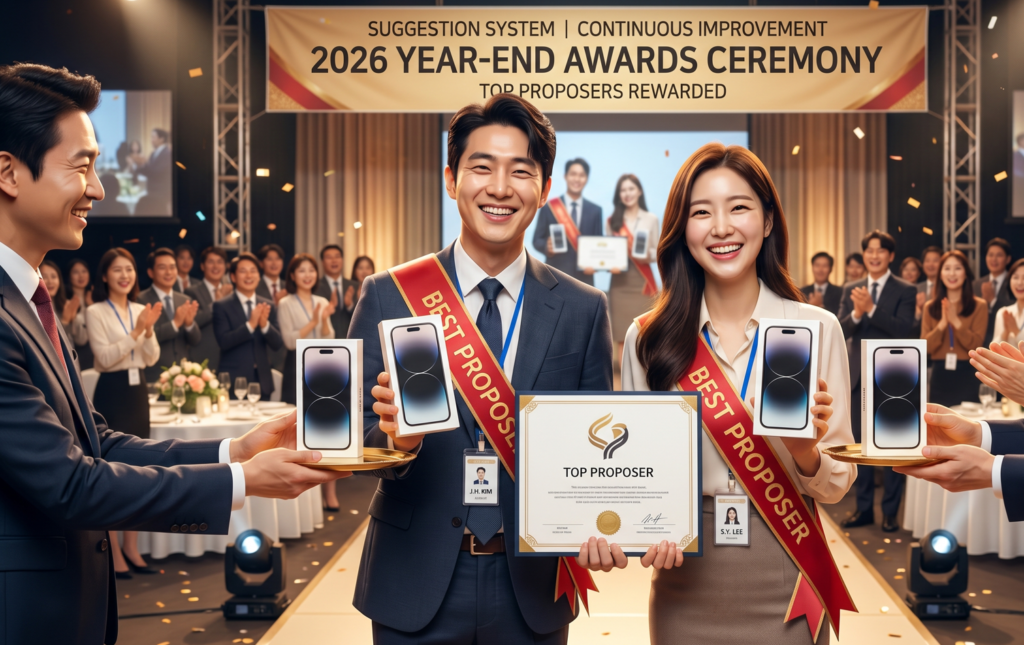
This high-value, culturally prestigious incentive generated immense excitement across our production lines. It transformed process optimization from a routine task into a highly competitive corporate sport, inspiring our technicians to look closer at their daily workflows and search for hidden efficiencies.
The Manager as an Innovation Coach
An incentive program is only as good as the support structure backing it. Under our governance model, direct managers were not allowed to act as passive gatekeepers. They were evaluated on their ability to act as frontline innovation mentors.
Managers were expected to regularly walk the shop floor, assist operators with data tracking, and explicitly train team members to lift the quality of their suggestion cards to a higher professional level. This structural shift ensured that our operators grew as tactical problem-solvers, cementing long-term operational resilience across our entire international manufacturing base.
6. Strategic Takeaways for Corporate Leaders
The operational success of the suggestion system at CS Wind Vietnam offers clear, actionable strategies for corporate leaders managing international branches or heavy industrial facilities:
- Lower the Friction for Feedback: The use of simple, standardized, bilingual physical and digital Suggestion Cards made it easy for operators to submit ideas immediately without getting bogged down in complex administrative procedures.
- Connect Rewards Directly to Clear Metrics: Using a transparent, weighted grading index eliminated any suspicion of managerial favoritism. Every worker knew exactly how their creative contribution translated into points, cash, or top-tier year-end prizes.
- Focus on Root-Cause Solutions: By explicitly banning superficial, buzzword-heavy cards (e.g., “strengthen management”), we forced our workforce to develop real analytical skills, ensuring that our plant floor became a self-healing operational ecosystem.
By designing an intuitive submission system, setting an aggressive monthly target, and offering high-value visual rewards like the latest iPhones, we unlocked the full creative potential of our frontline workforce. This strategic focus proved that with the right leadership structure, a traditional factory floor can become a powerful hub for global manufacturing innovation.
Why don’t you apply a Suggestion Program in your company ?
“Hungry for more? Check out these related posts.”
How to Turn SMART KPIs into Real-World Execution
Discover more from mfginsights.net
Subscribe to get the latest posts sent to your email.