Imagine if a scheduled train didn’t have a fixed timetable. If you couldn’t predict when it would depart or arrive, you wouldn’t be able to plan a business trip, and passenger safety would be severely compromised.
Now, consider traffic lights. The universal meaning of red, yellow, and green prevents chaos on the roads. If every country or city used different colors, the results would be disastrous. Even electrical outlets follow standardized sizes, allowing us to plug in a TV or an air conditioner without needing to rewire our entire homes for every new appliance.

These everyday rules ensure safety, convenience, and efficiency. We call the creation and observance of these rules Standardization. While it makes our daily lives easier, on the manufacturing shop floor, it is the absolute bedrock of survival and success. Mastering this framework is essential for manufacturing success.
Standardization on the Shop Floor: Beyond Basic Rules
In any manufacturing facility, basic operational rules are always in place—what time a shift starts, how long break times are, and strict safety protocols. However, the ultimate purpose of any production floor goes beyond just following the clock.
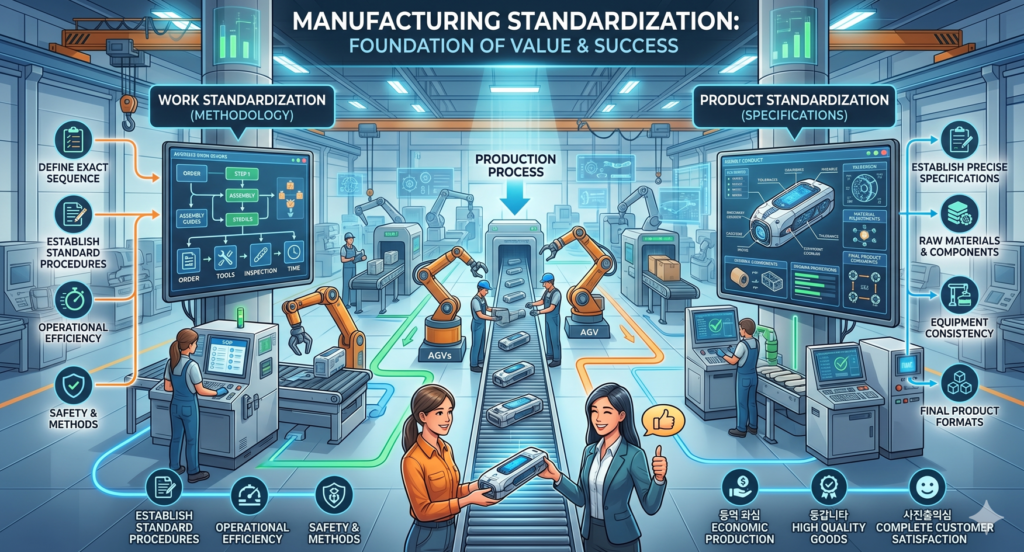
The core mission of manufacturing is to “economically produce goods that completely satisfy the customer.” Therefore, establishing standards directly tied to the production process itself becomes the most critical mission for any business leader. Generally, when we talk about this concept in the industry, we categorize it into two main pillars:
- Work Standardization (Methodology): This defines the exact sequence, procedures, and methods required to perform a specific job safely and efficiently.
- Product Standardization (Specifications): This establishes the precise specifications and formats for the final products, as well as the components, raw materials, equipment, and machinery required to build them.
The True Purpose: An Upward Spiral of Continuous Improvement
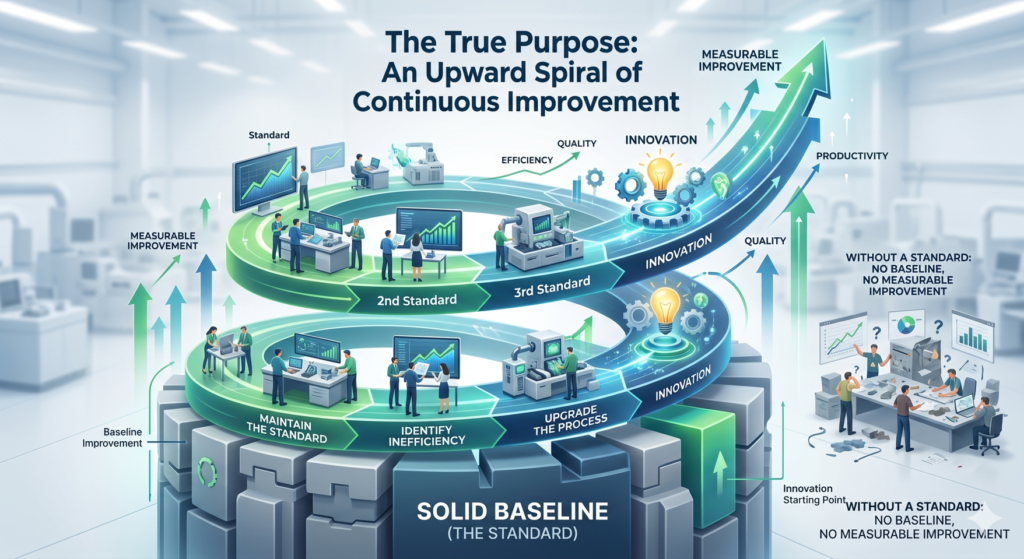
A common misconception is that standardization means locking a process in place forever. This couldn’t be further from the truth. The goal is not just to fix the current state of manufacturing.
True standardization establishes a solid baseline. Once a standard is set, it becomes the starting point for innovation. By repeatedly maintaining the standard, identifying inefficiencies, and upgrading the process, we create an upward spiral of continuous improvement. Without a standard, there can be no measurable improvement, as you have no baseline to compare your new results against.
Mastering the 4M Framework to Eliminate Variation
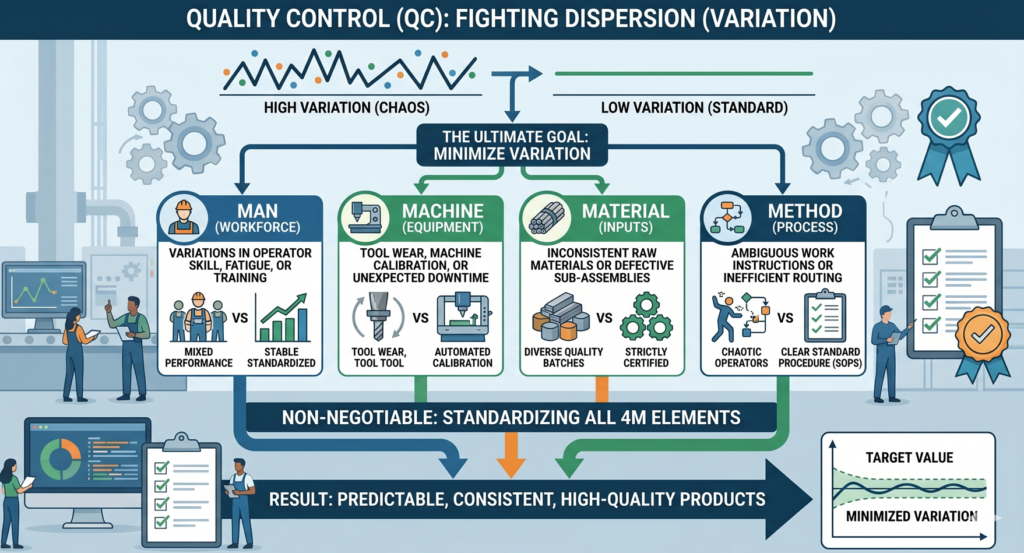
In Quality Control (QC), our biggest enemy is “dispersion” or variation in product quality. When defects happen, the root causes almost always trace back to the 4M Framework:
- Man (Workforce): Variations in operator skill, fatigue, or training.
- Machine (Equipment): Tool wear, machine calibration, or unexpected downtime.
- Material (Inputs): Inconsistent raw materials or defective sub-assemblies.
- Method (Process): Ambiguous work instructions or inefficient routing.
To minimize this variation, standardizing all four of these elements is non-negotiable.
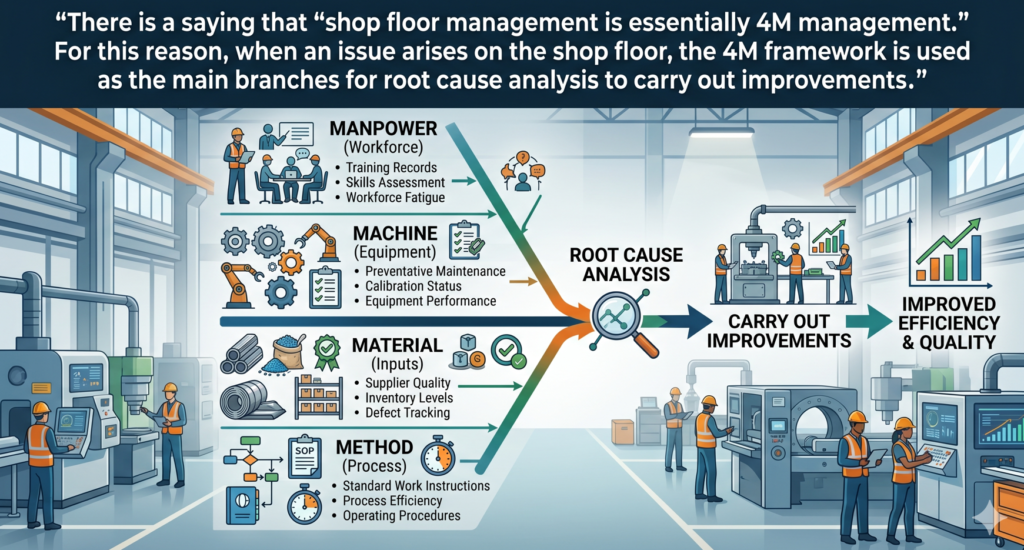
There is a saying that “shop floor management is essentially 4M management.” For this reason, when an issue arises on the shop floor, the 4M framework is used as the main branches for root cause analysis to carry out improvements.
Conclusion: The Bedrock of Quality Control
Standardization is the process of setting clear, unbreakable methods required for multiple partners, suppliers, and operators to work together seamlessly. Creating airtight standards and rigorously adhering to them is not just an administrative task—it is the foundational infrastructure required to drive robust Quality Control and long-term manufacturing profitability.
Start reviewing your shop floor today. Are your 4Ms truly standardized, or are you leaving your product quality up to chance?
💡 Further Reading &
For more insights on manufacturing excellence and strategic transformation, read more post below.
Discover more from mfginsights.net
Subscribe to get the latest posts sent to your email.