In the highly competitive global manufacturing sector, efficiency is not just a goal; it is a necessity for survival. True operational excellence begins with a fundamental concept: Standard Work. Rather than a rigid set of constraints, Standard Work serves as the ultimate baseline for continuous field improvement. By establishing a reliable standard, manufacturers can systematically identify waste, balance workloads, and optimize production flow.
Here are five proven strategies for driving field improvement through the disciplined application of Standard Work.
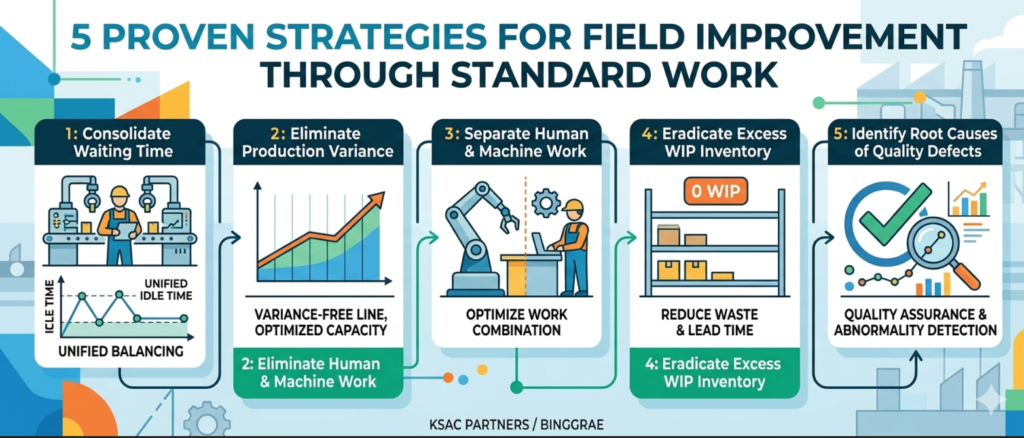
1. Consolidate Waiting Time to a Single Worker
One of the most critical aspects of field improvement is addressing workload imbalances between operators. It is a common misconception that simply reducing a fraction of a worker’s task saves money. In reality, reducing one person’s work by 0.9 does not lead to actual cost reduction. True cost savings are only achieved when workload improvements directly lead to headcount optimization.
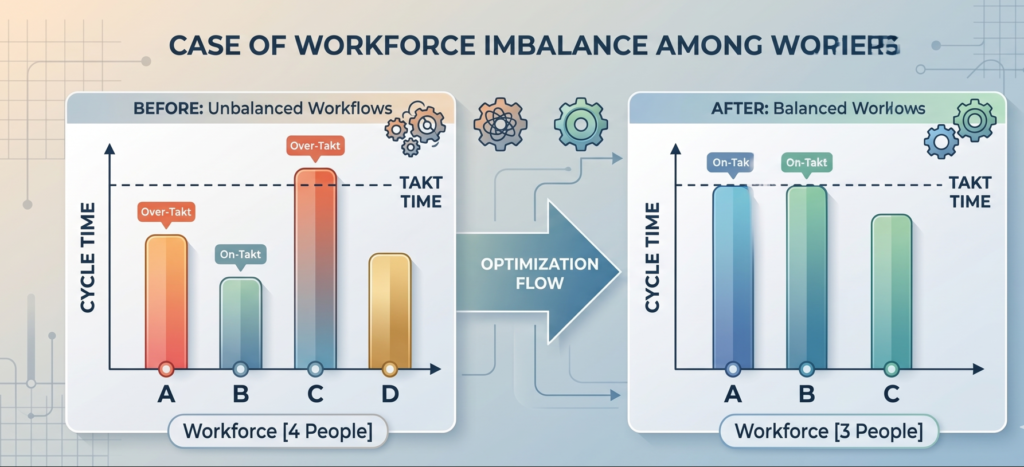
To achieve this, managers must actively reduce unnecessary movements and ensure continuous workflow across all processes. The goal is to push and consolidate all waiting time down the line to the final operator. Furthermore, when implementing these improvements, you must prioritize optimizing the human work methods first before investing capital into equipment upgrades.
2. Eliminate Production Volume Variance
Fluctuations in production volume are a symptom of an unstable process. In lines where variance exists, it is imperative to investigate and pursue the root causes. By systematically eliminating these causes, you create a variance-free production line, which naturally leads to an enhancement in overall production capacity. Utilizing visual management tools, such as production control boards, is a highly effective method for tracking this stability in real time.
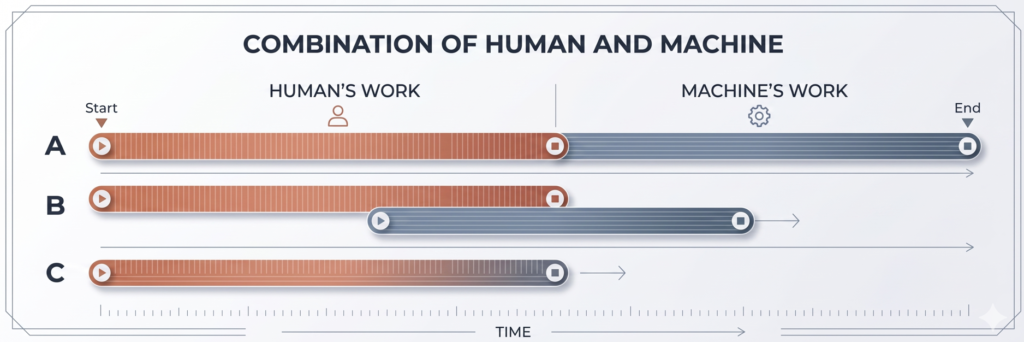
3. Separate Human Work from Machine Work
Efficiency does not always require pushing operators to work faster or running machines at higher speeds. Often, significant gains can be uncovered simply by re-evaluating how humans and machines interact. By clearly separating human tasks from machine tasks, you can increase production capacity just by changing the combination of their work sequences.
4. Eradicate Unnecessary Work-in-Process (WIP) Inventory
Many factory floors maintain excess Work-in-Process (WIP) inventory as a “comfort buffer.” However, this practice hides systemic flaws. Holding more WIP inventory than necessary directly results in the waste of overproduction. Additionally, it increases stagnation time, which severely elongates the overall production lead time.
To combat this, a strict standard for WIP inventory must be determined. By forcing a reduction in excess inventory first, you effectively lower the “water level” of the factory, bringing hidden operational problems to the surface where they can be resolved.
5. Identify the Root Causes of Quality Defects Early
Quality control is inherently tied to process adherence. When a process deviates from the established Standard Work, abnormalities will inevitably occur. Flow production relies heavily on workers maintaining Standard Work because it guarantees re-producibility. This strict adherence makes it significantly easier to pinpoint exactly where a defect occurred and what the true root cause is at an early stage.
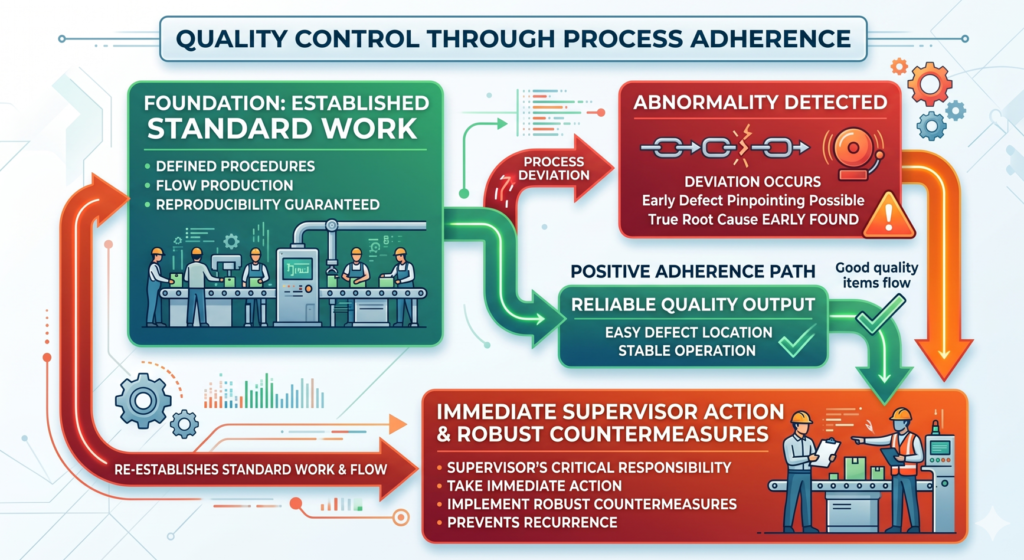
When an abnormality is detected, it is the supervisor’s critical responsibility to take immediate action and implement robust countermeasures to prevent recurrence.
Conclusion
Field improvement is a continuous journey that requires discipline, visibility, and a commitment to eliminating waste. By leveraging Standard Work to balance lines, separate human and machine tasks, and reduce WIP, manufacturers can build a resilient and highly productive shop floor.
💡 To learn more, feel free to read the post below.
Andon System Guide: Lean Manufacturing Essentials
Discover more from mfginsights.net
Subscribe to get the latest posts sent to your email.