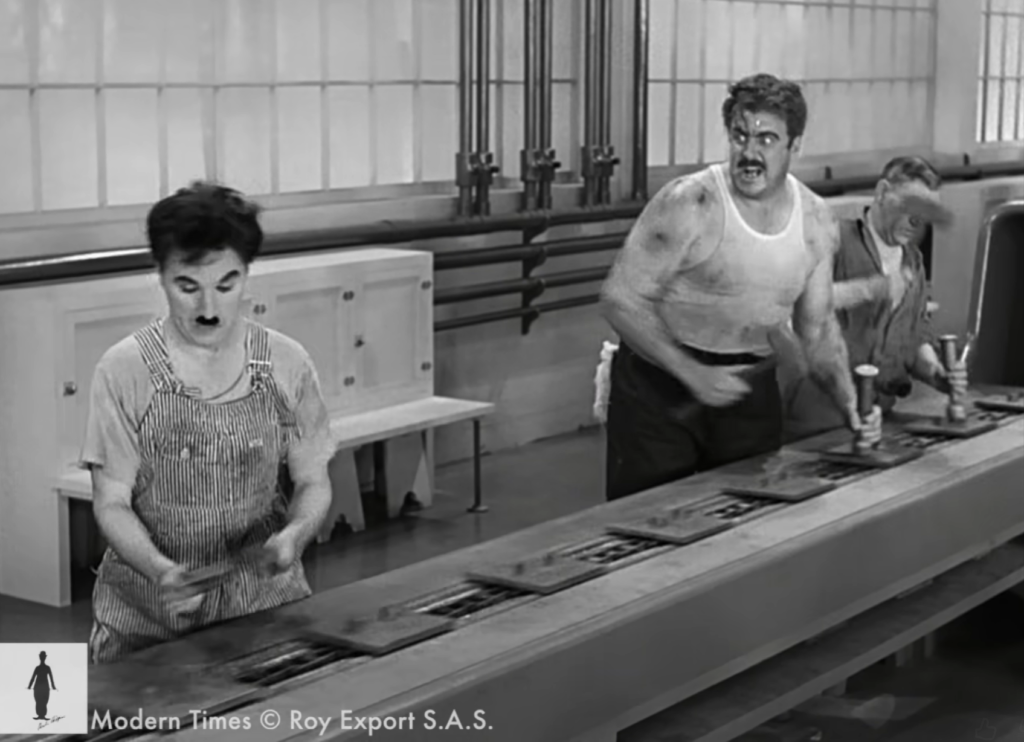
While the historical Ford System and Conveyors established the foundation of mass production, as consumer needs diversify, the manufacturing landscape is shifting from traditional “Mass Production” to “High-Mix Low-Volume Production. The conveyor belt system introduced by the Ford Motor Company is a hallmark of manufacturing innovation. However, behind this efficiency lay a “coercive” reality: workers had to synchronize their physical movements to the machine’s pace. Because the belt moved at a constant speed, even a few seconds of hesitation could trigger a chain reaction of delays, leading to production stoppages or defects in subsequent processes.
Occasionally, workers would push themselves to the limit to gain a fleeting moment of rest. Paradoxically, this often served as justification for managers to increase the conveyor speed, further intensifying the labor. Charlie Chaplin’s film Modern Times remains the most iconic portrayal of this tragedy—the human being swallowed by the machine’s velocity—through sharp, satirical humor.
Beyond Ford System and Conveyors: A Paradigm Shift in Manufacturing from Forced Speed to Autonomous Flow
As consumer needs diversify, the manufacturing landscape is shifting from traditional “Mass Production” with Ford System and Conveyors to “High-Mix Low-Volume Production.” This paradigm shift has fundamentally changed the design of the assembly line.
Modern systems still follow a specific sequence, but they utilize a flexible structure where work flows automatically to the next “Station” via chutes as soon as a task is completed. Today, the overall line speed is no longer dictated by the rigid rotation of a machine. Instead, the productivity of the entire line is determined by the worker’s skill level and the precision of the work sequence—specifically at the slowest process in the line.
[Case Study] Improving Productivity in a U.S. Manufacturing Plant by 7 Seconds
During a productivity analysis of an automotive chassis assembly line in the United States, we discovered a startling discrepancy: production reached nearly 300 units per hour during the day shift but plummeted to 190 units during the night shift.
The cause of this massive gap was not the equipment or the environment; it was “Motion Waste” and “Waiting Waste” by individual workers. The process was a relatively simple, repetitive task—loading parts into the machine, waiting for automated processing, and unloading them. Yet, the efficiency gap based on the worker’s skill and technique was far greater than expected.
The data revealed that while Worker A had a cycle time of 12 seconds, Worker B took 19 seconds for the exact same loading task. This 7-second difference stemmed from subtle habits in the sequence of movements.
While “7 seconds” might seem trivial, when calculated for an 8-hour shift over 22 working days a month, the difference in output swells to a staggering 19,360 units. This case clearly demonstrates how micro-motion analysis and the elimination of small wastes profoundly impact a company’s competitive edge.
![[Case Study] Improving Productivity in a U.S. Manufacturing Plant](https://mfginsights.net/wp-content/uploads/2026/05/표준6-1024x648.png)
[Video] 12-Second Cycle Time Case (Click to watch) → cycle time 12 seconds
[Video] 19-Second Cycle Time Case (Click to watch) → cycle time 19 seconds
Conclusion: The Magic of 7 Seconds—Micro-Motion Analysis Creates a Miracle of 20,000 Units
This U.S. case study offers a vital lesson. The massive productivity gap (110 units per hour) between day and night shifts was not a result of equipment performance or raw materials. The “culprit” was hidden in plain sight: the micro-movements and sequences of individual workers.
The way a mere 7-second difference (12s vs. 19s) compounds into a monthly gap of nearly 20,000 units illustrates how “Motion Waste” can be fatal to corporate profitability. (A video of this case study is available on my YouTube channel.)
💡 Expert Advice
Many companies consider expensive equipment investment to boost productivity. However, the first step should always be analyzing on-site motions through data.
- Refine Motion Analysis: Break down every movement—from the moment a part is picked up to the moment it is loaded—into micro-segments. (The use of video analysis tools is highly recommended.)
- Establish Optimal Standardized Work: Identify the movements of the most efficient workers, establish them as the “Standard Work,” and train all employees based on this benchmark.
- Visualize Waste: Use data to visualize “pauses” or “unnecessary movements.” Creating an environment where workers can recognize and improve problems themselves is the core of Kaizen culture.
Ultimately, in the era of High-Mix Low-Volume production, competitiveness depends on how precisely you optimize the motions of the bottleneck process. Just as a 7-second improvement created a miracle of 20,000 units, remember that micro-motion refinement leads to macro-scale corporate profits.
“Hungry for more? Check out these related posts.”
The Power of the PDCA Report in 4 Steps
Discover more from mfginsights.net
Subscribe to get the latest posts sent to your email.