To prevent stagnation and leap into the ranks of the global Top 3, companies must establish crystal-clear goals and back them with relentless execution. Boosting revenue, maximizing productivity, upgrading quality, shortening lead times, and cutting costs are core values pursued by every organization. However, simply chanting the slogan “Let’s work harder!” will never drive meaningful change.
To align your organization’s energy and generate tangible results, you must apply the Target Management when designing your SMART KPI (Key Performance Indicators).
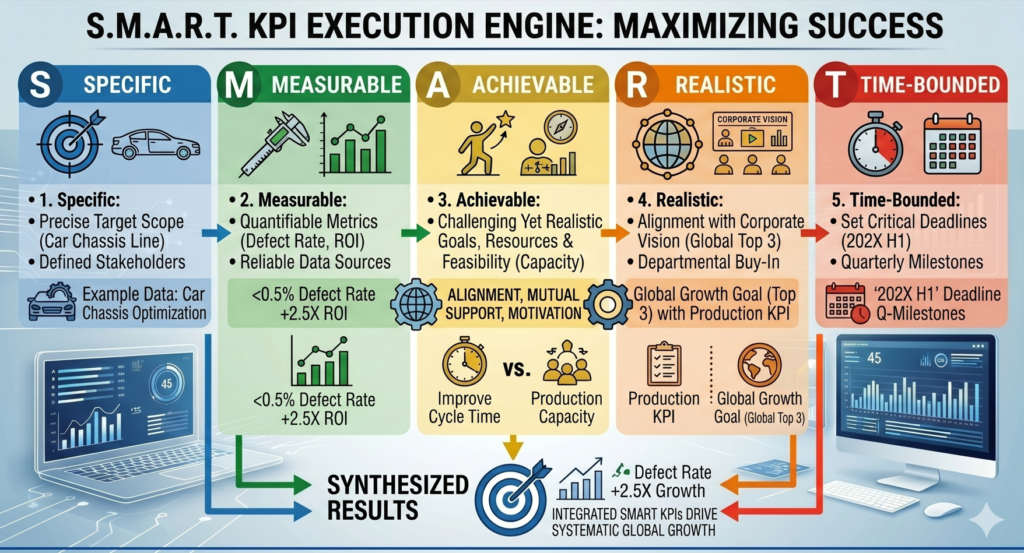
5 Pillars of Designing a Powerful SMART KPI
1. Specific: Clear Goals Drive Execution
A goal must be so concrete that anyone can grasp it immediately. For instance, instead of a vague directive like “Let’s increase productivity,” define the scope and target sharply: “Improve the processing efficiency of the car chassis assembly line.” Specific goals provide team members with clear, actionable guidelines.
2. Measurable: What Gets Measured Gets Managed
Performance must be proven with data and hard numbers. Instead of “improving quality,” establish quantified metrics such as “maintaining a defect rate below 0.5%” or “reducing production costs by 10%.” This allows you to objectively evaluate your current baseline and manage progress against targets in real time.
3. Achievable: Challenging Yet Realistic Targets
Competition in the global market is brutal. Goals should be challenging enough to stretch your organization’s capabilities to their absolute limit, yet realistic enough to be achieved. When team members feel that a goal is within reach, true immersion and a creative Kaizen (continuous improvement) spirit are unlocked.
4. Realistic: Aligning Targets with the Corporate Vision
You must evaluate whether established metrics align with the company’s long-term vision and currently available resources. Sacrificing quality to pump up short-term revenue, or aggressively cutting equipment maintenance budgets for a temporary cost reduction, is not real growth. Every department’s KPI must stay perfectly aligned with the company’s ultimate vision of breaking into the global market.
5. Time-Bounded: A Goal Without a Deadline is Just a Wish
Every performance indicator must have a definitive expiration date. Avoid ambiguous phrasing like “by the end of this year.” Instead, lock down specific milestones, such as “by the end of the first half of 202X” or “at the close of each quarter.” Setting explicit deadlines injects a healthy dose of tension and creates a framework for prioritizing critical tasks.
💡 Expert Insight: Micro-Improvements Create Macro Miracles
World-class global enterprises focus intensely on the slightest waste of motion and mere seconds of cycle time. Just as a micro-improvement of 7 seconds in a single operator’s motion can generate a massive delta of 20,000 units in monthly output, refining your corporate KPIs through the SMART framework is where true innovation begins.
Break away from the ritualistic, administrative goal-setting that repeats every year. By managing data-driven, specific, and measurable metrics, your organization can outgrow its yesterday and ultimately stand proud among the global Top 3.
Beyond Goal Setting : Driving Alignment, Ownership, and Incentives
Setting clear KPIs is simply drafting the architectural blueprint for innovation. The next phase—sharing those metrics and fostering active employee ownership—is where you actually construct the building.
No matter how brilliant a strategy is, it remains nothing more than ink on paper if the workforce doesn’t understand or connect with the vision. Real growth begins when metrics move off management’s desks and onto the plant floor as live execution.
1. Tailored Departmental KPIs and Structured Action Plans
Once macro-level corporate goals are locked in, they must be translated into the distinct functional language of each department. Every team needs to break down the corporate vision into micro-KPIs tailored to their specific scope.
The secret lies in building a step-by-step Action Plan to support these metrics. It is never enough to just state what needs to be achieved; it requires deep strategic thought into how it will actually be accomplished.
2. Visual Management: Keeping the Target in Sight
To keep goals top-of-mind and maintain a high level of motivation across the workforce, organizations must practice Visual Management.
Hanging large banners featuring core targets across the facility or setting up real-time digital dashboards ensures that every employee interacts with the destination during their daily routine. This constant visual exposure creates an unspoken accountability and serves as a powerful unifying tool that signals, “We are one team.”

3. Transparent Incentive Systems and All-Hands Alignments
The intense effort poured into innovation must always be validated by fair, tangible rewards. Management should build a concrete incentive protocol tied directly to achieving targets and present it transparently during all-hands meetings.
When workers fully understand the metrics governing their rewards, they become deeply motivated owners of the innovation process. This communication bridge does more than just transfer information—it cements trust, proving that the company’s growth directly translates into personal prosperity.

Target Management : The Phenomenal Growth Born from Collective Focus
The success of an innovation initiative is never driven solely by a handful of brilliant managers or the willpower of an executive. While leadership dictates the heading, the massive tidal wave of change is generated exclusively by the collective strength of the people operating on the front lines. When every employee internalizes a KPI as their own personal target and rides the wave of innovation together, the company develops a level of competitive edge that can weather any market storm.
During my 5-year tenure as the legal representative and Managing Director of our corporate subsidiary in Vietnam, I personally spearheaded an annual “6-Week Productivity Optimization Project” to systematically restructure the plant floor’s DNA.
This sustained commitment to innovation expanded our manufacturing capacity exponentially, giving us the operational leverage to pursue an aggressive global bidding strategy. As a direct result, our revenue only in Vietnam entity—which sat at 120 billion KRW in 2017—experienced compounding year-over-year growth to surpass 500 billion KRW by 2021. During that same window, our local workforce doubled from 550 to over 1,050 employees, transforming the facility into the benchmark regional subsidiary.
※ Recommended Articles to Read Next on This Blog:
Link 1: The True Power of 5S: 5S Methodology Lean Strategy
Link 2: SMART KPI : How to Turn SMART KPIs into Real-World Execution
Discover more from mfginsights.net
Subscribe to get the latest posts sent to your email.