It is easy to manage a factory when you have enough money. The real test of leadership happens when the company is losing money and facing hard times.
This is the real-world case study of a Manufacturing Factory Turnaround Strategy in Vietnam. In 2017, the facility was operating with an annual revenue of 120 billion KRW (approx. $100 million USD) and managed a direct production workforce of 550 local employees. Having previously executed a successful turnaround of a deficit-ridden plant in China and serving as its General Manager , I was suddenly called upon to handle an escalating crisis in Vietnam.
Part 1: The Misdiagnosis of a Failing Plant
The Vietnam facility had recently secured contracts for brand-new product. However, because these products had never been manufactured by the local team before, the plant suffered from high initial defect rates, a sharp drop in labor productivity, and skyrocketing operational costs. The quarterly financial results were rapidly plunging into a severe deficit crisis.
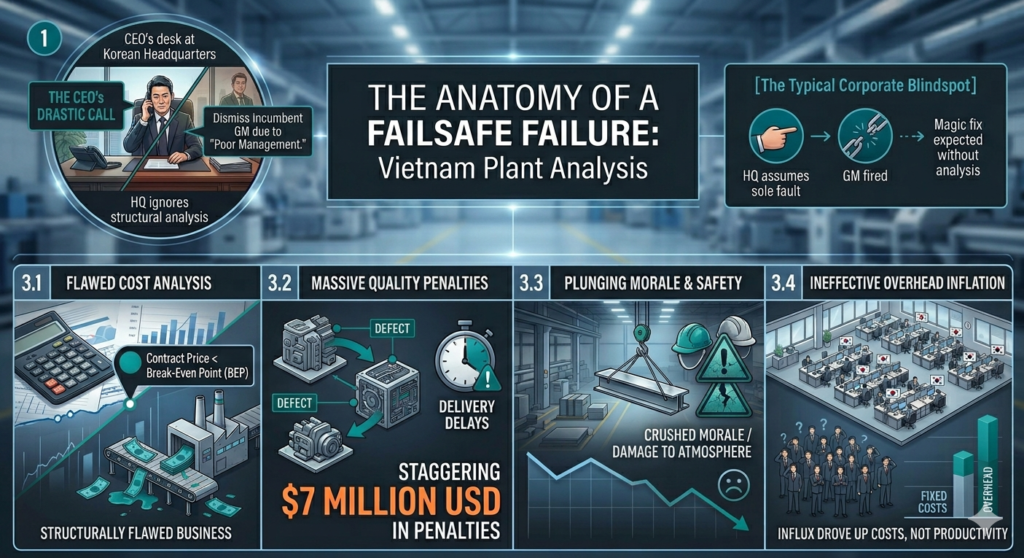
Recognizing the emergency, the CEO at the Korean headquarters called me with a drastic measure: they intended to dismiss the incumbent Korean General Manager due to “poor management” and transfer me immediately to fill the vacancy.
However, after quietly cross-checking the situation with other expatriates on the ground, I discovered that the impending deficit was not merely the current GM’s fault. It was a systemic, multi-layered failure caused by several critical blindspots:
- Flawed Cost Analysis: The initial process and cost analyses for the new products were poorly executed. The contract unit price was actually set below the Break-Even Point (BEP). It was a structurally flawed business where the plant lost money on every single unit it produced.
- Massive Quality Penalties: Due to a lack of experience with the new product, delivery delays escalated, resulting in a staggering $7 million USD in customer claims and penalties.
- Plunging Morale from Safety Incidents: Poor handling of heavy materials caused severe workplace safety accidents. This severely damaged the factory atmosphere and crushed the morale of local workers.
- Ineffective Overhead Inflation: The Korean headquarters had dispatched roughly 20 Korean managers to provide “support.” However, instead of improving quality or productivity, this massive influx only drove up overhead and fixed costs.
Part 2: Leadership in the Face of Reluctance
At the time, the Korean headquarters had 15 senior executives. Yet, knowing the severe state of the Vietnamese plant, absolutely every single one of them refused to take the position. With no other takers, the CEO urged me to accept the transfer.
Initially, I declined the offer. I requested to stay in China for an additional six months to fully stabilize our operations and secure domestic orders there. But as the situation in Vietnam worsened, the CEO approached me once more with an urgent plea.
While I respected corporate orders, I decided to negotiate a condition that would protect the dignity of my colleague and ensure a smooth transition:
“I will accept the assignment on one condition: Instead of firing the current Vietnam GM, swap our positions. Send him to the stabilized China entity as the new GM.”
For the current Vietnam GM, moving to an unfamiliar environment in China wasn’t ideal, but it was far better than being terminated; he had no other viable options. It was also a massive shift for my own family, who had successfully adapted to life in China. However, I wanted to protect a fellow leader under immense pressure while ensuring the company survived. With the leadership transition secured, here is the real-world case where I systematically executed a Factory Turnaround Strategy using Lean tools such as 7 Wastes reduction and Mutual trust & respects.
Part 3: The First Day—Shifting the Hierarchy of Value
On my very first day at the Vietnam factory, we held the official handover ceremony.
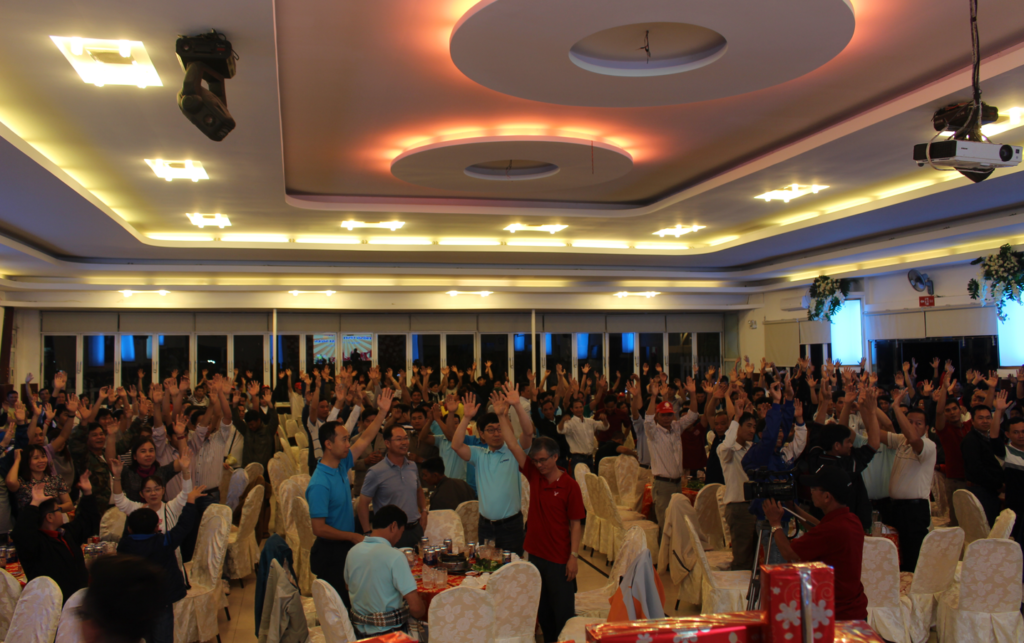
Standing in front of all 550 employees(Day shift 300, Night shift 250), I chose not to deliver a typical corporate speech. Instead, I asked a simple question:
“Do you know who the most important person in this factory is?”
A few workers shouted, “The General Manager!” I shook my head. “No, try again. Who is the most important person in Vietnam?” Others replied, “The President of Vietnam!”
I smiled and asked one final time: “No. Let me ask you again. Who is the most important person in the entire world?”
Only then did the crowd realize what I was looking for. Together, they shouted, “ME!”

I closed my address with a promise: “Moving forward, I will manage this factory so that every single one of you realizes your own immense individual value. I ask you all to join me in bringing this plant back to life.”
Part 4: The Factory Turnaround Strategy (Step-by-Step)
To reverse a deep deficit, a leader cannot rely on motivational speeches alone. We executed a highly structured, data-driven strategy divided into three main pillars: Goal Alignment, Aggressive Cost Reduction, and Employee Welfare Transformation.
1. Goal Alignment & Mindset Reset
You cannot motivate a workforce without high yet attainable goals. To break down inter-departmental silos, I organized an offsite workshop for 30 department heads and administrative staff at a high-end luxury hotel and restaurant. Through team-building exercises and a relaxed atmosphere, we established aggressive Key Performance Indicators (KPIs) while building genuine trust.
2. Radical Structural Cost Optimization
The annual losses meant we needed to stop the financial bleeding immediately. I ordered the head of finance to list every major expense item. Leveraging my past experience in China—where we successfully minimized expat overhead down to just two personnel—we began restructuring.
- Expatriate Overhead Reduction: In early 2016, the Vietnam plant originally carried a heavy burden of 13 Korean expatriates. However, inspired by my aggressive moves to slash expat overhead during my tenure in China, the Vietnam entity followed suit and reduced its count by 5. Consequently, when I officially took over as General Manager in October 2016, the number had already come down to 8. Once on the ground, I accelerated this restructuring: within my first 6 months, I transferred 3 more expatriates to other entities. Within a year, I streamlined the team further, leaving just 2 Korean expatriates (myself as General Manager and the CFO) to run the entire operation—drastically minimizing our fixed corporate overhead.
- Administrative Restructuring: The total number of local administrative staff was 110 employees. Through a fair severance and voluntary resignation package, we streamlined the team to 70. Crucially, to maintain high motivation, the remaining 70 staff members were given an immediate 10% salary increase.
- Supply Chain & Procurement Disruption: We aggressively overhauled our sourcing to break expensive vendor monopolies:
| Category | Previous Sourcing Strategy | New Cost-Optimized Strategy |
| Manufacturing of sub-parts | Expensive Outsourcing | 100% In-house Production |
| Logistics | High External Warehousing Costs | Newly Leased Storage space inside factory grounds |
| Consumables | Standard departmental spending | Mandatory 10% cost-reduction target |
| Steel Plates | 100% Sourced from Korea | 50% Switched to China |
| Industrial Paint | 100% Sourced from Denmark | 50% Switched to China |
| Consumable Equipment | 100% Korean Equipment | 100% Chinese Equipment via Transparent Bidding |
| Welding Materials | 100% Sourced from USA | 50% Korea / 50% China Split |
3. Transforming Employee Welfare and Morale
True productivity comes when workers feel safe, respected, and heard by the company, I launched a formal employee suggestion system, a financial mindset training program, and a strict zero-accident campaign. When analyzing initial employee feedback, I realized that the workers weren’t asking for complex corporate bonuses—they were asking for basic human dignity and workplace improvements.
We executed the following changes immediately:
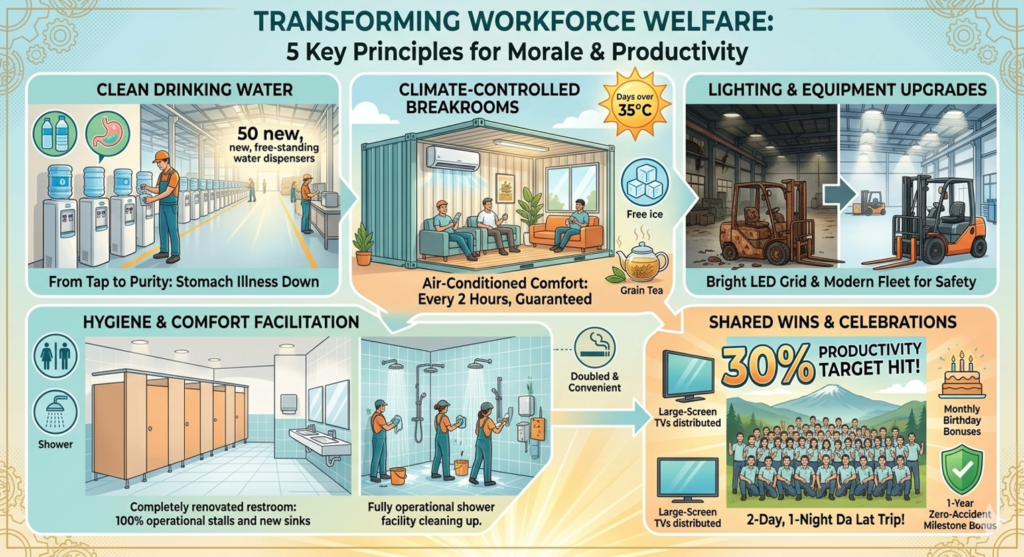
- Clean Drinking Water: Vietnam’s temperatures hover between 25°C and 35°C year-round. Workers had been drinking tap water, leading to frequent stomach illnesses. We partnered with an outside vendor to install 50 free-standing water dispensers across the entire plant floor.
- Climate-Controlled Breakrooms: The shifts allowed a 15-minute break every 2 hours, but there was nowhere comfortable to rest. We converted shipping containers into 10 air-conditioned breakrooms right next to the production floor. On days exceeding 35°C, we provided free ice and traditional roasted grain tea.
- Lighting and Equipment Upgrades: The dark factory floor made operations difficult and dangerous. We replaced the entire factory lighting grid with bright, modern LEDs. Additionally, we disposed of a breaking 30-year-old forklift fleet and replaced them with newer, well-maintained pre-owned models under 5 years old.
- Hygiene and Comfort Facilitation: We doubled the number of outdoor smoking areas to reduce transit time. More importantly, we completely renovated the factory restrooms, which had been 50% clogged and poorly maintained, and installed fully operational shower facilities so workers could clean up before heading home.
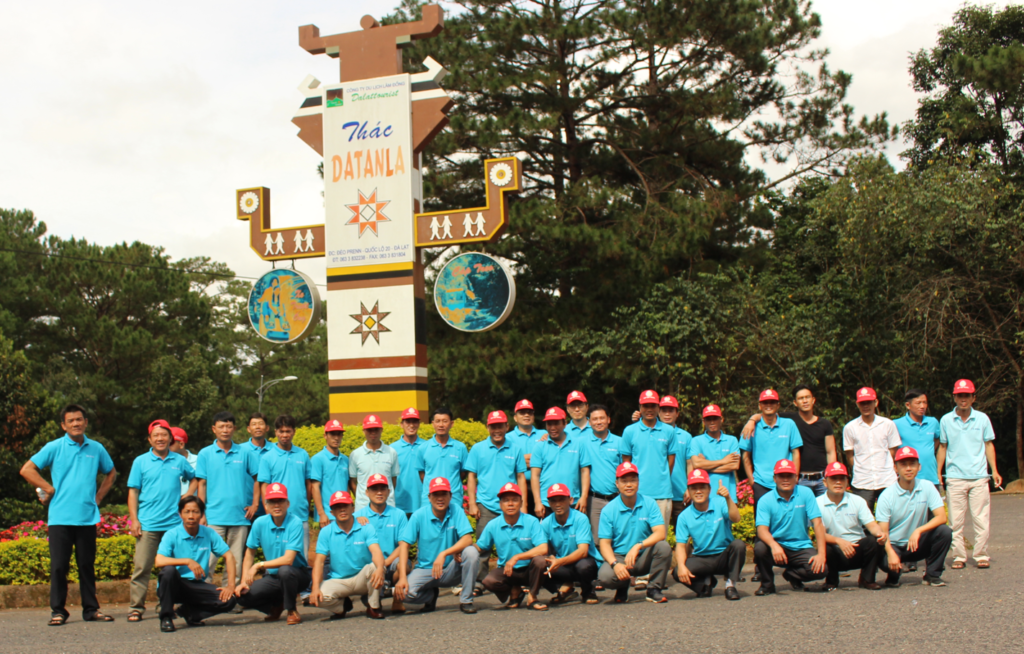
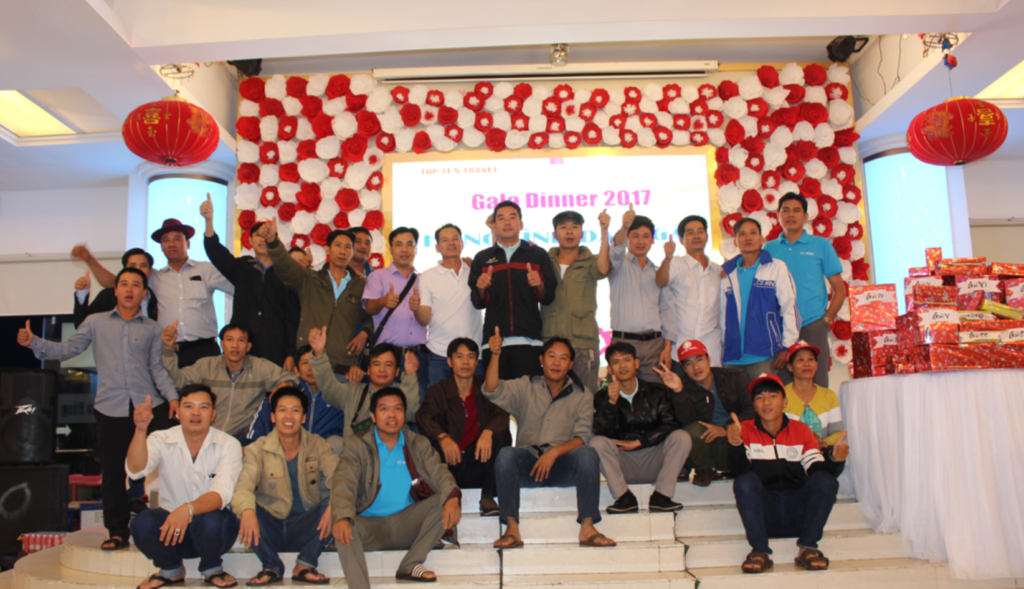
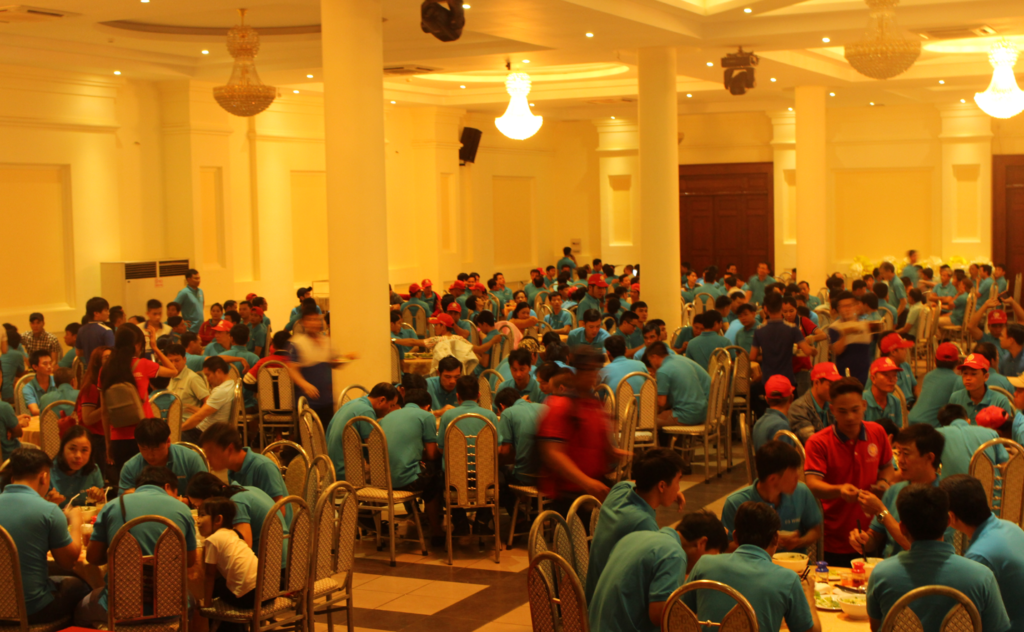
- Shared Wins & Celebrations: I promised the entire workforce that if we hit our 30% productivity growth target, I would take everyone on a 2-day, 1-night company trip to Da Lat. We hit the target, and all 550 employees went on the trip. We also distributed high-end gifts (such as large-screen TVs) during end-of-year ceremonies, paid out monthly birthday bonuses, and offered a facility-wide bonus for hitting a 1-year zero-accident milestone.

Part 5: The Results—A Spectacular Turnaround
After 15 months of relentless, synchronized effort from management and the local workforce, the 2017 year-end numbers showed an undeniable operational miracle. The factory didn’t just survive—it shattered previous company records.
Financial & Operational Performance Overview
Verified Financial Data Table
| Year | Sales Revenue(USD) | Operating Income (USD) | Operating Margin (%) |
| 2016 | $34,000,000 | -$2,300,000 | -7% |
| 2017 | $107,000,000 | $18,400,000 | +17% |
Key KPI Breakthroughs:
- Revenue Growth: Achieved an astonishing 214% increase year-over-year.
- Profitability Flip: Pivoted from a dismal -7% operating loss in 2016 to an incredible 17% operating profit margin in 2017.
- Labor Productivity: Per-capita manufacturing productivity surged by 35%.
- Workplace Safety: Reached a perfect milestone of 0 safety accidents.
What This Crisis Taught Me
The success of the Vietnam factory turnaround was not achieved by cutting corners or blindly blaming local staff. It was realized by identifying the structural flaws in procurement, eliminating heavy expatriate overhead, and actively investing in the health, safety, and dignity of the local workers on the line.
When you treat your factory floor workers not as easily replaceable expenses, but as the most important people in the organization, they will step up to save the company. True operational turnaround starts when leadership shifts from assigning blame to empowering people.
Following our successful turnaround in 2017, this sustained commitment to innovation and facility expansion allowed us to scale our manufacturing capacity exponentially. This gave us the operational leverage to pursue an aggressive global bidding strategy.
During my 5-year tenure as the legal representative and Managing Director of our corporate subsidiary in Vietnam, I personally took the lead in an annual ‘6-Week Productivity Optimization Project’ to systematically rebuild our factory floor system.
As a direct result, our annual sales revenue in the Vietnam entity, which sat at $107 million in 2017, experienced compounding year-over-year growth to surpass $440 million by 2021. During that same window, our local workforce doubled from 550 to 1,050 employees, transforming the facility into the benchmark regional subsidiary.
For more insights on manufacturing excellence and strategic transformation, read more post below.
A Factory Turnaround Case Study: Turning Deficit into Profit in China
3 Proven Habits of High-Performing Leaders
3 Lessons the Flea Experiment Teaches Us About Success
Discover more from mfginsights.net
Subscribe to get the latest posts sent to your email.