What is the most dangerous moment on a manufacturing floor? It is not when a machine breaks down or a quality defect occurs. The real danger is “when a problem occurs, but absolutely no one knows about it.” Invisible problems cannot be solved, and minor defects left ignored eventually spiral into catastrophic losses, such as major line shutdowns or severe customer claims.
In this post, we will take a deep dive into the Andon system in Lean manufacturing—a powerful tool for Lean innovation that instantly visualizes operational abnormalities and triggers an immediate organizational response.
1. What Is the Andon System?
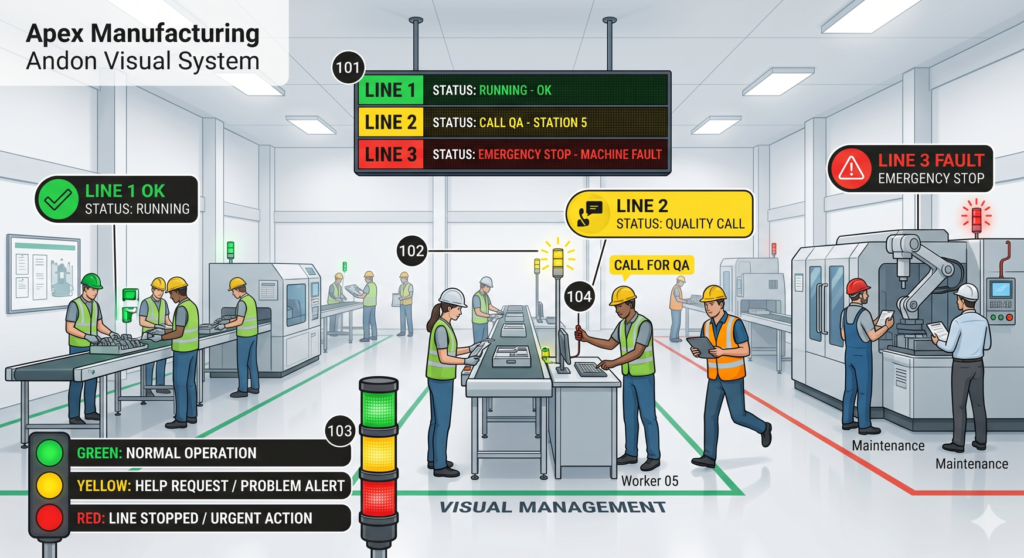
The word ‘Andon’ (行灯) originally means “paper lantern” in Japanese. Just like a lantern illuminating a dark night path, an Andon system in Lean manufacturing refers to a visual management tool that instantly flags abnormalities on the production floor using lights and sounds.
Originating from the world-renowned Toyota Production System (TPS), this setup empowers operators to pull an ‘Andon cord’ or press a button the moment they detect a quality issue or need assistance. This action signals the entire floor. Beyond just sending a warning, it embodies a fierce quality philosophy: “Stop the line until the problem is solved.”
2. Three Core Components of an Andon System
An effective visual shop floor relies on a combination of sharp audio and visual devices:
- Andon Board: A large electronic display board mounted high on the factory ceiling or in highly visible areas. It provides real-time visibility into which line and which specific process is experiencing an issue.
- Signal Lights (Tower Lights): Three-color stack lights attached to individual machines or workstations. Typically, they display three states:
- 🟢 Green: Normal operations (Running)
- 🟡 Yellow: Help requested / Abnormal symptoms detected
- 🔴 Red: Line stopped / Emergency situation
- Audio Alerts: Unique melodies or alarm sounds accompany the visual lights, ensuring that supervisors and engineers immediately notice the situation even if they are looking away.
3. Why Andon Is the Core of Quality Management
Implementing an Andon system in Lean manufacturing fundamentally shifts the management culture of a factory:
- Immediate Visibility of Waste: Hidden waste and defects are forced to the surface. Instead of sitting in an office waiting for daily reports, managers can immediately run to the illuminated workstation to provide on-the-spot shop floor (Gemba) coaching.
- Realizing Jidoka (Autonomation): Jidoka implies smart automation where a machine or line stops automatically when an error occurs. Andon organically connects human operators and machines, stopping defects from ever advancing to downstream processes.
- Building a Support Ecosystem: It builds a culture where workers feel empowered to voice problems rather than hiding mistakes. Andon is not a surveillance tool to monitor operators; it is a supportive distress signal designed to help them maintain flawless quality.
[Case Study] The Autonomous Nervous System of an Injection Molding Plant: How Andon Works
This real-world case study highlights the application of an Andon system within a plastic injection molding process to maximize shop floor responsiveness through real-time visualization.
By tracking the color shifts of the Andon boards and tower lights, you can see Visual Management in action:
- 🟢 Normal Operation (Solid Green – Running): The entire process flows smoothly without interruptions.
- 🟡 Request for Quality Support (Yellow Light – Call for QA): The operator proactively presses a button next to the injection molding machine to request a quality inspection.
- 🔵 Request for Technical Support (Blue Light – Call for Technical): Triggered when tooling (mould) or mechanical maintenance is needed. The engineering team detects the alarm in their office and arrives at the machine within 5 minutes.
- 🔴 Abnormal Shutdown (Red Light – Stop): The injection molding equipment has halted due to a critical machine fault or emergency. Supervisors and maintenance teams rush to the site within 5 minutes to troubleshoot the root cause.
“A problem that cannot be seen cannot be managed.” > The Andon system brings every single abnormality into the light, driving managers to immediately run to the Gemba and execute targeted Kaizen (continuous improvement) activities.
4. Operational Strategies from a Lean Expert
Having managed global manufacturing plants for over two decades, here are the non-negotiable practical principles I followed to successfully sustain an Andon system in Lean manufacturing:
Do Not Fear the “Line Stop”
The number one reason Andon systems fail is that managers panic over temporary drops in utilization rates and pressure operators not to stop the line. Management must instill deep trust: “Stopping the line right now is the fastest way to solve the problem permanently.”
Define a Clear Escalation Path
When a light turns on, it must be crystal clear who must arrive, within how many minutes, and what action they must take. If a yellow light blinks and no one shows up, the Andon system becomes completely useless.
Connect It with Smart Data (Smart Andon)
In modern smart factory environments, the frequency and types of Andon triggers must be logged as digital data. Analyzing these trends allows you to bridge daily floor alarms with structural Kaizen activities to eliminate recurring defects.
Conclusion: Andon Is the Lantern of Shop Floor Transparency
Deploying an Andon system is not merely a technical project of hanging electronic scoreboards. It is a profound process of building a culture of trust where problems are exposed transparently, and the entire organization collaborates to fix them.
Light up your manufacturing floor with the lantern of Andon, visualize your hidden waste, and take your next definitive step toward total quality control.
🔗 Recommended Readings From This Blog:
Discover more from mfginsights.net
Subscribe to get the latest posts sent to your email.