1. What is Creative Problem Solving through Brainstorming ?
Brainstorming is a technique devised by Alex Osborn in the 1930s. Utilizing Creative Problem Solving through ‘Brainstorming’ is absolutely essential—not only in manufacturing but also in investing. It involves pouring out ideas freely, as if a “storm” is raging within the “brain.” This process is absolutely essential—not only in manufacturing but also in investing—to capture opportunities that others might overlook.

2. The Four Golden Rules of Brainstorming
To ensure effective brainstorming, it is crucial to adhere to the following rules:
- No Criticism: Refrain from immediate criticism, no matter how absurd an idea may seem. Creativity flourishes in freedom.
- Freewheeling: Cast aside doubts like “Will this actually work?” and let your imagination soar.
- Quantity over Quality: By generating a vast quantity of ideas first, you are bound to discover a hidden gem among them.
- Combination & Improvement: Combine different ideas to create a better alternative. (e.g., The stability of savings + The profitability of stocks = Long-term investment in blue-chip stocks).
To maximize the “Four Golden Rules,” using Post-it notes is one of the most effective ways to visualize and organize thoughts.
- Silent Generation: Every participant writes their ideas on Post-it notes individually. This ensures that even the quietest team members can contribute without fear of criticism.
- Displaying Ideas: Stick all the notes on a large board or wall. At this stage, remember the rule: Quantity over Quality.
- Affinity Diagramming: Group similar ideas together. This is where Combination & Improvement happens, as we see how different thoughts connect to form a better solution.
- Voting and Prioritization: Use small stickers to vote on the best ideas. This helps the team focus on the “Way to Solve” the most critical problems first.
[ Real-world Examples of Brainstorming ]
1. Solving Everyday Problems: The Birth of ‘Post-it’
- The Problem: It was viewed as a failed invention and faced being scrapped.
- The Brainstorming: Art Fry, another researcher, was frustrated with the paper markers falling out of his hymnbook. Through brainstorming, they asked, “What if we use this weak adhesive for bookmarks?” This led to the global hit product, the Post-it.
2. Business Innovation: Pixar’s ‘Plussing’
- The Method: Instead of saying “No” to a colleague’s idea, they use “Yes, and…” to expand upon it.
- The Case: During the production of Toy Story, the basic idea of “What if toys came to life?” was refined through repeated plussing, resulting in worldwide success.
3. Investment and Economy: Ronald Read’s ‘Contrarian Brainstorming’
- The Situation: Thinking about how to build wealth on an ordinary salary.
- Ideation: “Should I buy a flashy car like others, or use that money for stocks?” “Should I chase tech stocks or buy blue-chip stocks I know?”
- The Result: He concluded that frugality and long-term dividend investing were the keys, accumulating $8 million by age 92.
4. Marketing Strategy: Domino’s Pizza ‘Turnaround’ Campaign
- The Brainstorming: “Let’s honestly admit our weaknesses and show our change!”
- The Result: They advertised their complete recipe overhaul, turning a crisis into an opportunity and causing their stock price to skyrocket.
5. Shop Floor Improvement: ‘KAIZEN’ Activities
- The Situation: An auto parts factory faced a sudden spike in assembly line defect rates.
- KAIZEN Brainstorming: Instead of a closed management meeting, they used the “5-Why” method with line workers.
- “Why the defects?” → “The parts don’t fit well.”
- “Why don’t they fit?” → “It’s too dark to see properly.”
- “Why is it dark?” → “The shelf location is blocking the light.”
- The Result: Rather than expensive equipment replacement, a simple solution—repositioning the shelf and installing LED lights—reduced the defect rate by over 30%.
- In manufacturing, brainstorming is the powerful engine behind KAIZEN—eliminating waste and increasing efficiency.
- When faced with harsh criticism that their pizza tasted like “cardboard,” Domino’s took a bold approach.
- Ronald Read’s success can be seen as a result of self-reflective brainstorming.
- Pixar developed brainstorming into a unique culture called “Plussing.”
- This is one of the most famous success stories. 3M researcher Spencer Silver accidentally created a “weak” adhesive that stuck well but peeled off easily while trying to develop a strong one.
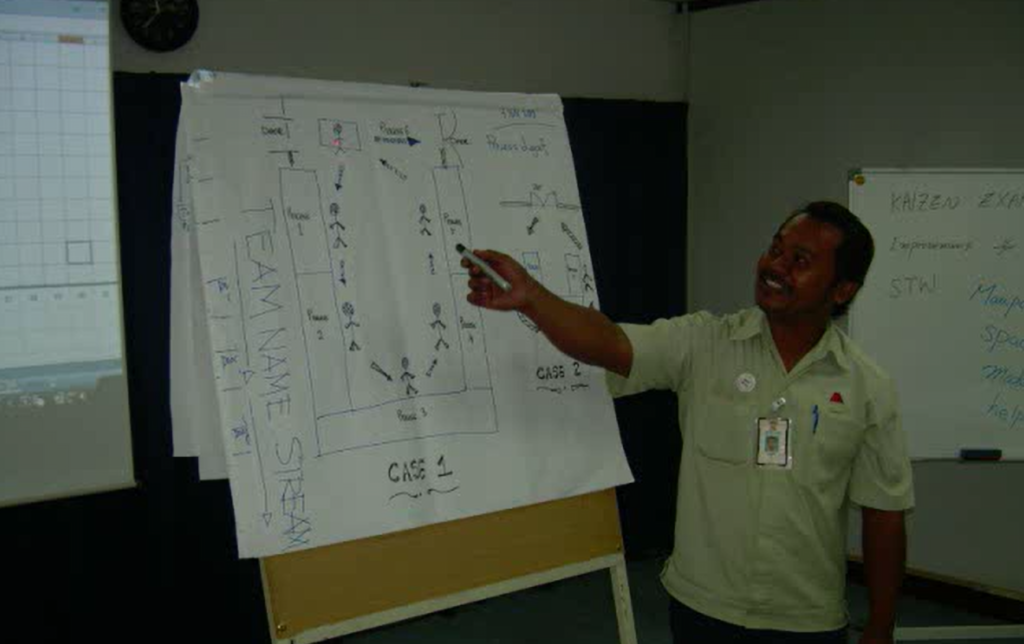
Click here to watch Kaizen Competition Video(You Tube) :
Case Study of Kaizen in Malaysia
Why Brainstorming is Essential for KAIZEN Activities
- Reflecting the Voices from the Shop Floor: As is core to Lean Six Sigma, drawing out even the smallest inconveniences from the field through brainstorming enables practical and substantial improvements.
- The Power of Collective Intelligence: While individual contemplation has its limits, brainstorming as a team allows for the rapid identification of unexpected ‘Muda’ (Waste) factors.
- Continuous Motivation: By witnessing their own ideas being implemented in the actual process, employees take pride in being ‘problem solvers’ rather than mere laborers, which further stimulates their creative thinking.
The Power of Data in KAIZEN: How We Slashed Failure Rates from 4.3% to 0.2%
“True innovation on the shop floor isn’t just about tidying up; it’s about statistical process control and measurable results. Here is a real-world example of how a technical adjustment led to a massive quality breakthrough.
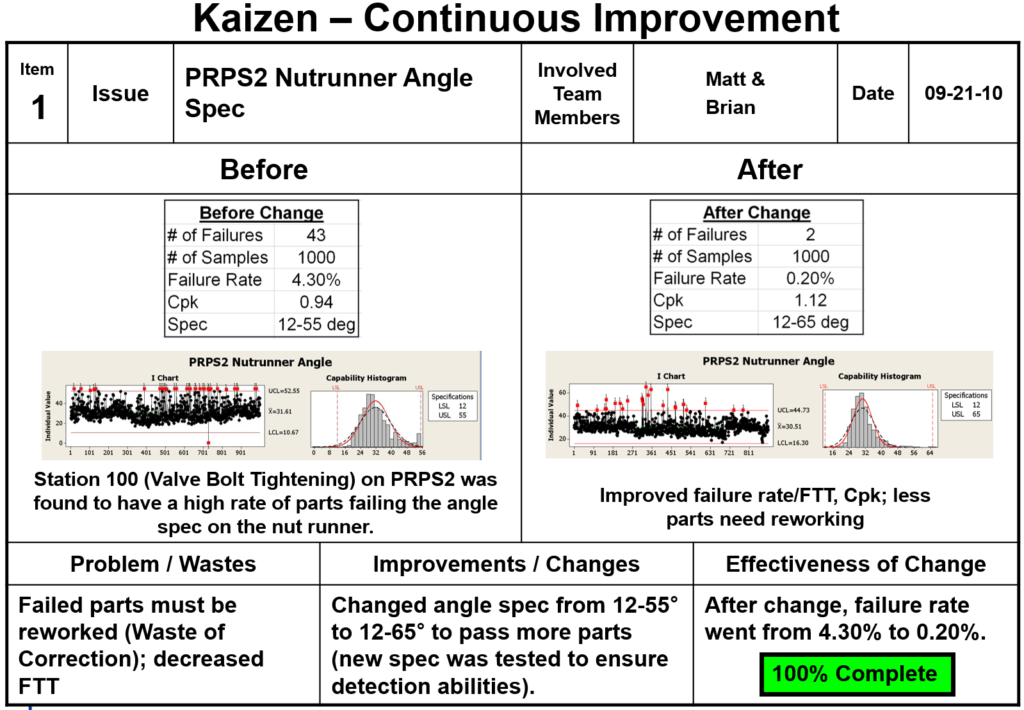
1. The Issue: High Failure Rates at Station 100
At the valve bolt tightening station, we faced a high rate of parts failing the nut runner angle specification. This resulted in a 4.30% failure rate and a low Cpk of 0.94, meaning the process was not capable of meeting quality standards consistently.
2. The Problem (Waste of Correction)
Failed parts required extensive rework, which is a classic ‘Waste of Correction’ in Lean manufacturing. This directly decreased our First-Time-Through (FTT) rate and increased operational costs.
3. The Improvement: Technical Specification Optimization
Instead of settling for the status quo, the team (Matt & Brian) analyzed the detection abilities and optimized the angle specification from 12-55° to 12-65°. This change was thoroughly tested to ensure quality integrity while allowing for process natural variability.
4. The Remarkable Effectiveness of Change
The data speaks for itself:
- Failure Rate: Dropped from 4.30% to 0.20%.
- Process Capability (Cpk): Improved from 0.94 to 1.12.
- Result: Significant reduction in rework and improved FTT.
This is the result of what I always emphasize to my teams in the U.S., China, and Vietnam: “Don’t just work hard, work with data.” Small adjustments, when backed by statistical analysis, can lead to 100% completion of innovation goals.”
During my tenure as the President & CEO of our overseas factory, I always made it a top priority to integrate KAIZEN (continuous improvement) activities directly into the shop floor. To foster this culture, I established an initiative with 5 teams, each consisting of 6 cross-functional members, and launched a bi-monthly “KAIZEN Competition.”
Every cycle, we challenged each team to submit and implement at least 20 substantial improvement cases. Our judging panel conducted a fair and rigorous evaluation to select the Winner and Runner-up teams, celebrating their success with awards that ignited a competitive spirit and provided continuous motivation across the entire factory.
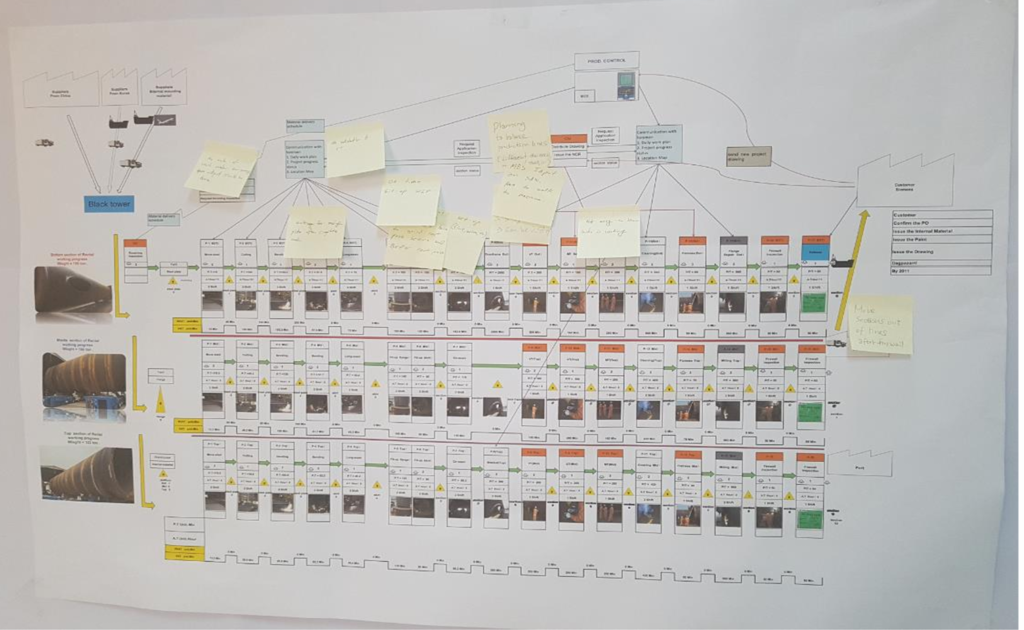
The results were truly remarkable. In a single year, we successfully executed 600 unique KAIZEN improvement cases. These 600 cases didn’t just make our operations better; they translated directly into significant advancements in Safety, Quality, Productivity, and, ultimately, Cost Reduction across our entire shop floor. It is a testament to the power of empowering people to eliminate waste and drive sustainable innovation.
“Innovation is not about grand equipment investments; it begins with listening to the smallest inconveniences on the shop floor. When 600 small improvements gather over a year, they create miracles in safety, quality, and extraordinary profits. I hope the seeds of innovation are planted in your workplace today. Together, We Can Do It!“
“Hungry for more? Check out these related posts.”
Andon System Guide: Lean Manufacturing Essentials
Lessons from the Pain of Innovation: The 70-Year Lifespan of the Eagle
Overcoming a $33K Tower Ovality Crisis
SMED Guide: How to Slash Die Change Time by 67%
Discover more from mfginsights.net
Subscribe to get the latest posts sent to your email.