Introduction: The Hidden Drain of Industrial Logistics
In lean manufacturing, identifying transportation waste is crucial. We relentlessly hunt down the “Seven Deadly Wastes.” While overproduction and defects often take center stage, Transportation Waste(Muda) silently destroys profit margins behind the scenes. Moving materials or finished goods adds zero value to the customer—it only adds risk, lead time, and massive operational costs.
This challenge becomes exponentially critical when dealing with mega-heavy industries. Imagine managing finished products where a single unit stretches 50 meters in length, spans 4 meters in diameter, and weighs a staggering 50 tons. Outside of aerospace and shipbuilding, these are some of the largest monolithic structures moved on Earth.
![[Case Study] Crushing Transportation Waste : SITV Port and Tower storage](https://mfginsights.net/wp-content/uploads/2026/05/image-95-1024x541.png)
Click here to watch the full drone footage on YouTube
When production volumes surge, standard storage and internal logistics break down. This case study explores how a leading wind tower manufacturing facility in Vietnam systematically dismantled transportation waste, re-engineered its spatial layout, and unlocked massive cost savings through agile leadership and strategic negotiation.
1. The Context & The Scaling Crisis (Statement of Context)
In July 2017, our wind tower manufacturing plant in Vietnam faced a high-stakes operational bottleneck. The global demand for renewable energy components was skyrocketing. Our facility, which had successfully delivered 2,000 wind towers annually in 2017, was tasked with scaling production to 3,000 units for 2018—a massive 50% capacity surge.
While our production lines were capable of handling the acceleration, our physical footprint was not. Wind towers demand immense footprint area for fabrication, sandblasting, coating, and final pre-delivery storage. The plant’s internal yard quickly hit maximum storage capacity.
To prevent a total shutdown of the production flow, we urgently needed to secure massive external storage yards (Yards) to cushion the finished goods inventory before client shipment.
2. Phase 1: Eliminating the 800-Meter Logistical Loop (Challenge & Action)
The immediate reaction of the local procurement and operations teams was conventional: search for available industrial land scattered across the region. They initially utilized the Dong Nam Yard, located 800 meters away from the primary manufacturing facility.
However, from a Lean perspective, this 800-meter gap was a logistical nightmare. Transferring a 50-ton wind tower outside the factory gates to an isolated yard required an absurd amount of resource allocation:
- Two heavy-duty reach stackers working in tandem.
- Supporting forklift fleets for stabilization.
- Continuous rental of Self-Propelled Modular Transporters (SPMTs)—specialized multi-axle heavy platform vehicles.
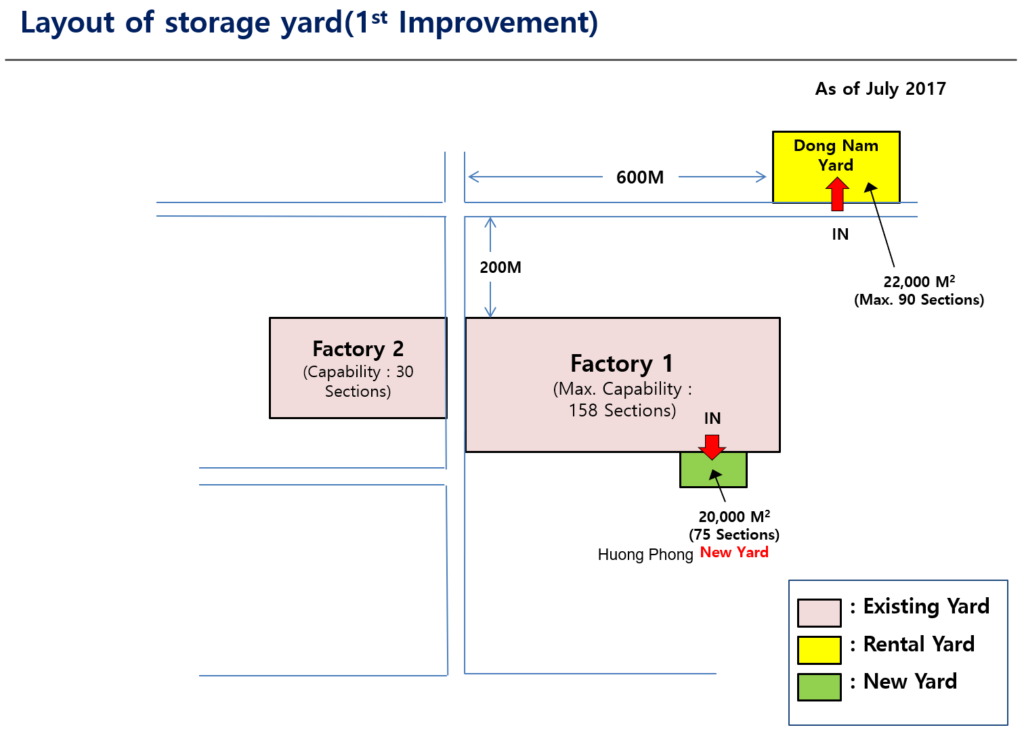
The process was slow, highly hazardous, and financially draining. The rental fee for the Dong Nam Yard stood at a steep $4.50 / M2 / Year. On top of that, every single round-trip transfer utilizing the rented SPMT vehicles slapped an extra $100 per trip onto our operational expenses.
[Traditional Logistics Waste Loop]
Factory 1 ──(800M via High-Cost SPMT Travel)──> Dong Nam Yard ($4.50/M²)
The Lean Intervention: Layout Optimization
True innovation often starts with acute observation. While the team was busy driving around the industrial zone looking for distant properties, I noticed a vast, vacant plot of land sitting directly adjacent to our factory wall.
A lean spark ignited: “If we rent this exact plot, break down a section of our perimeter wall, and create a direct internal link, we completely eliminate external road transport, transit permits, and high-cost rental vehicles.”
I immediately tracked down the landowner. Following intensive rounds of strategic negotiations, we successfully signed an exclusive lease for the 20,000M2 Huong Phong Yard.
[Lean Optimized Direct Flow]
Factory 1 ──(Immediate Boundary Wall Breakthrough)──> Huong Phong New Yard ($2.15/M²)
Phase 1 Financial & Operational Results
By breaking the wall and establishing the Huong Phong New Yard, we achieved a double-whammy victory in cost and efficiency:
- Unit Rental Savings: The lease for the Huong Phong Yard was secured at just $2.15/ M2/ Year—less than half the cost of the Dong Nam Yard ($4.50 / M2/ Year). For a 20,000 M2 footprint, this single negotiation stripped $48,000 / year off our fixed overhead.
- Logistical Waste Elimination: Because the new yard was directly connected internally, the need for external SPMT rentals evaporated for this sector. This saved an astonishing $90,000 / Year in variable transportation costs.
- Total Phase 1 Savings : $138,000 / Year.
Click here to see the ellimination of Transportation Wastes(YouTube)
3. Phase 2: Port-Side Storage Re-Engineering (The Next Bottleneck)
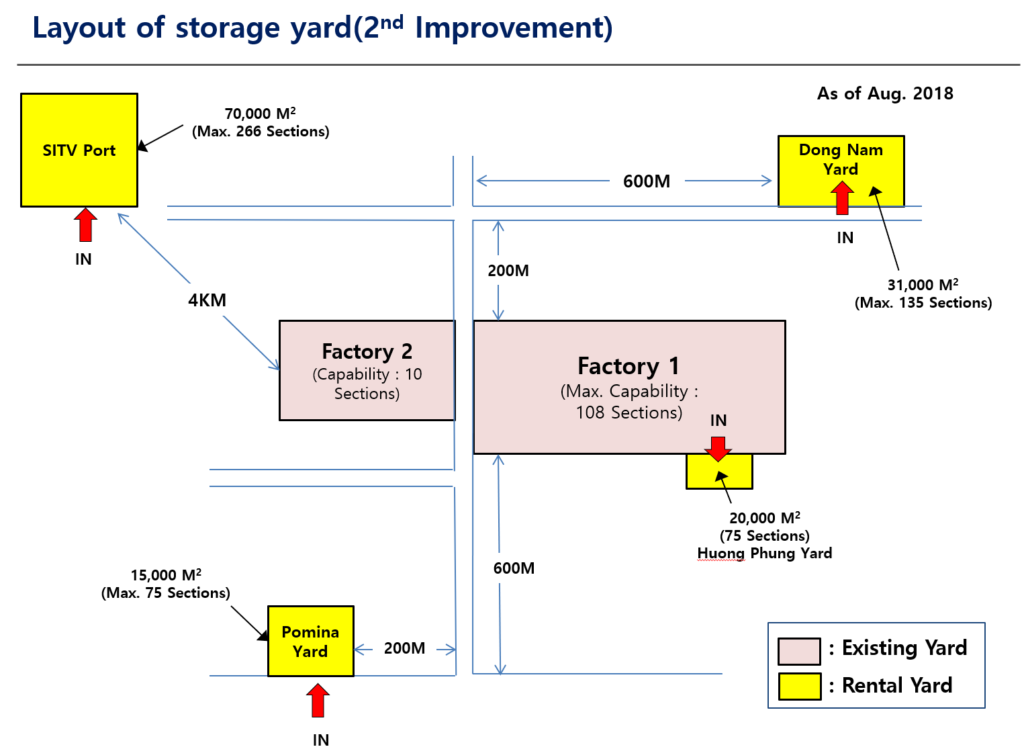
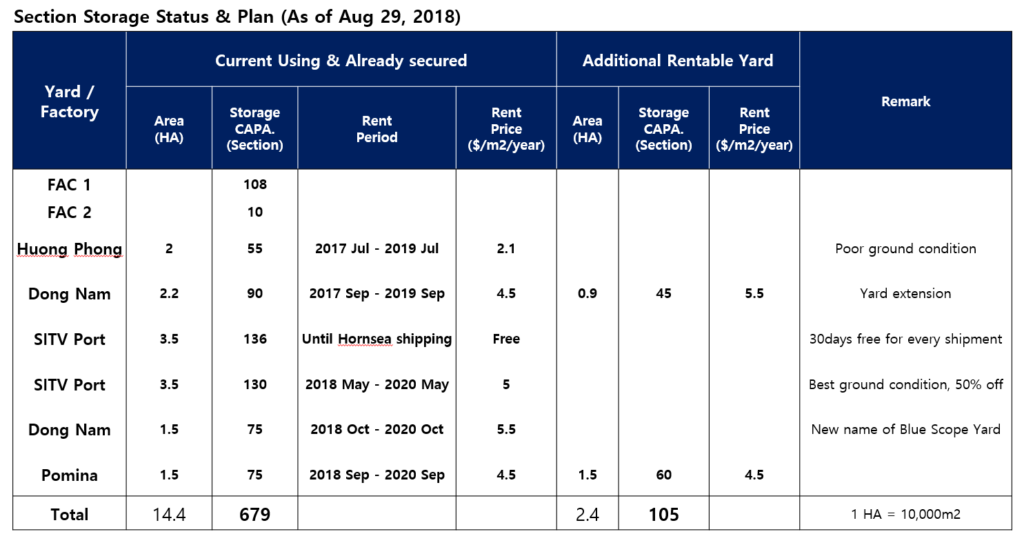
As 2018 progressed, our production volume continued its aggressive upward trajectory. The newly acquired Huong Phong Yard filled up, forcing us to lease additional decentralized satellite yards (including expanding Dong Nam and acquiring Pomina Yard) to handle the absolute peak loads. Our overall rental footprint swelled to 14.4 Hectares (144,000 M2) across multiple zones.
Logistical complexity and cumulative rental fees were climbing fast. The primary issue was our port-of-loading. We were utilizing the standard PTSC Port for final maritime vessel loading. However, PTSC enforces a strict, zero-tolerance policy regarding long-term storage; towers had to be brought in right before the ship arrived because of its tight and busy schedule. This meant we had to store towers at our satellite yards, load them onto SPMTs, transport them to the port, and unload them again—creating heavy double-handling waste.
The Strategic Action: The SITV Port Alliance
To kill this double-handling and transport waste, we looked for a disruption. A newly established, modern facility called the SITV Port caught our attention. As a newcomer in the maritime market, they possessed extensive open storage land but lower initial vessel traffic.
Recognizing a mutual win-win potential, I met directly with the President of SITV Port. By leveraging our massive, guaranteed shipping volumes, building deep professional rapport, and navigating multiple high-level negotiations, we forged a landmark partnership:
- Free Cushion Storage: SITV granted our company 30 days of completely free yard storage for every single outbound shipment (specifically optimized for projects like Hornsea).
- Cut-Rate Premium Space: For long-term designated storage across 70,000 M2 (7 Hectares) of premium, top-tier ground condition space, they agreed to a massive 50% discount compared to market standard rates, locking it in at $5.00 / M2 / year.
[Lean Port-Side Integration]
Satellites/Factory ──> SITV Port (70,000 M² Integrated Storage & Direct Loading)
Phase 2 Financial & Operational Results
By transforming a transit port into an integrated storage-and-loading hub, we bypassed standard industrial bottlenecks:
- Direct Yard Rental Cuts: The optimized contracts and free storage windows carved out an immediate $175,000 / year in pure rental savings.
- SPMT Variable Savings: Integrating storage right at the water’s edge drastically limited secondary shunting, saving an extra $319,200 / year in heavy vehicle costs.
- Total Phase 2 Savings: $494,200 / Year.
Conclusion: Key Lean Takeaways for Global Leaders
Through this dual-phase logistics overhaul, our facility didn’t just survive a 50% production spike—we thrived, pocketing well over $632,200 annually in direct, auditable logistics and rental cost reductions.
But the real value of this Lean journey goes far beyond the balance sheet:
- Unmasking Hidden Labor Costs: Traditional accounting only tracks direct rental invoices. Lean management looks at the human cost. By eliminating unnecessary transport loops, we saved hundreds of man-hours for our internal operators, riggers, and safety staff, allowing them to focus on core production value.
- Challenge “Proximity Bias”: Don’t let your team assume that the only solution to expansion is buying property further away. Sometimes, the most elegant lean solution is hiding right on the other side of your own boundary wall.
- Turn Vendors into Partners: High-cost operational blocks (like strict port storage limits) can be bypassed through creative B2B negotiations. By aligning our storage crisis with a new port’s need for volume, we created a highly profitable ecosystem.
Transportation waste is a silent profit killer. If you map your value streams, look over your perimeter walls, and aggressively optimize your spatial layouts, you can unlock massive hidden capacity and capital without changing a single machine on your shop floor.
Want to dive deeper into Lean Innovation? Check out the related article below.
7 Wastes : The Definitive Guide to Eliminating Non-Value-Adding Activities
Mastering Line of Balance (LOB) for Manufacturing Productivity
Decision-Making: 1 Fatal Trait of Incompetent Managers
Discover more from mfginsights.net
Subscribe to get the latest posts sent to your email.